Right off the bat I’m going to start by saying no, I’m not saying Marquette is a good team and this season has been vindicated. Barring a miracle run through the Big East Tournament, this season will have been a failure. There is no advanced metric to change the win/loss column.
But all you need is eyes to see that this version of Marquette we have seen in the 2026 calendar year is a MUCH better version than the one we saw in 2025. And this is where advanced numbers do come in handy.
I saw a handful of people respond, well of course Marquette looks better, the Big East SUCKS. And while you won’t see me standing up for the conference’s honor today, the beauty of advanced metrics is that you can adjust the results based on both tempo (how many possessions were played) and opponent quality.
In the Tweet above, you can see that Marquette ranks 54th in D1 since January 1st in defensive efficiency, and you can also see that the column header reads ADJDE. That’s because Bart Torvik’s data adjusts the actual results to account for the various differences, primarily opponent quality and pace.
For example, Marquette gave up 1.237 points per possession against DePaul (80 points in 65 possessions) right after giving up 1.233 PPP against St. John’s (92 in 75 possessions). Those are both quite bad, but to account in differences in opponent quality, sites like Torvik’s allow us to see what that adjustment looks like. Despite giving up around 1.23 to both, the AdjDE against DePaul was significantly worse (120.7) than against the Johnnies (109.1).
Which is all a long winded way of saying, getting a couple wins against the dregs of the conference isn’t the reason why morale has improved around Marquette. It’s using the eye test and then verifying it with metrics that bake in the fact there are a lot of meh teams MU plays in conference play. And what those numbers are telling us, is this is a completely different team than the one we saw in November and December.
And as luck will have it, Marquette has now played 14 games in 2025 and 14 in 2026, this season, going 5-9 in both. If you just looked at the record, you’d miss a pretty compelling story that the team we’ve seen in 2026 is nothing like the one we saw in 2025.

Again, the wins and losses are what matters for success, and going 5-9 in any 14 game stretch isn’t good by anyone’s calculation. But the performances in those games have changed subsantially.
But what changed?
On opening night, Marquette trotted out the following starting lineup:
PG: Sean Jones
SG: Chase Ross
SF: Zaide Lowery
PF: Ben Gold
C: Caedin Hamilton
Of those 5, 2 (Lowery and Jones) haven’t played a minute in 2026 and Caedin has only played 15+ minutes twice, with 8 single-digit-minute games after logging 1 of those in 2025. And while starting isn’t the end all be all, that radical shift in trusted personnel is the most glaring change.
To be fair though, it’s not like those 5 started every game in 2025. Sean Jones started 3 before getting injured before ceding his spot to Nijel James forever, only playing in 5 more games before missing the rest of the season due to injury. Zaide started the first 9 games before getting benched, played 2 games there and then was never to be seen again.
This is not meant to scapegoat those 3 players for the poor results, either. None of those 3 cracked 50% of minutes played. They weren’t major contributors on the floor, and weren’t the only reason for the historically bad start. There is plenty of blame to go around.
The reason I highlighted them is because under Shaka, Marquette has used its roster continuity as a pretty large advantage, able to beat great teams early in the season. All 5 were returning players with at least 2 seasons of experience. Shaka bet on that experience and continuity to pay dividends once more. It did not come close.
The transition to “the future” wasn’t necessarily swift outside of Nigel, for injury reasons, but it did mean that Marquette started to rely more and more heavily on players with limited experience, which hasn’t been the case in his tenure.
Nigel played 30+ minutes 4 times in 2025, and has now done it in 12 straight games in 2026.
Royce Parham played 30+ minutes 1 time in 2025, and has now done it 9 times in 2026.
Adrien Stevens played 25+ minutes 1 time in 2025, and has now done it all 14 games in 2026.
Glow Ups
Of course it’s easy to say “why didn’t you play them that much from the beginning” in hindsight, but relying on 2 true freshmen and a sophomore with 0 starts is only part of the story. The bigger story is that these young players took the lumps in 2025 and have truly blossomed in 2026.
Below I’m going to paste a screenshot from Hoop-Explorer, which may be the most valuable free-tool I’ve ever come across, basketball or other wise. One of the features it has is allowing us to split the season into parts, and then see the individual changes in advanced metrics from players in that timeline while filtering out garbage time. The A row will represent 2025, the B row 2026.
Focus on Nigel for now.
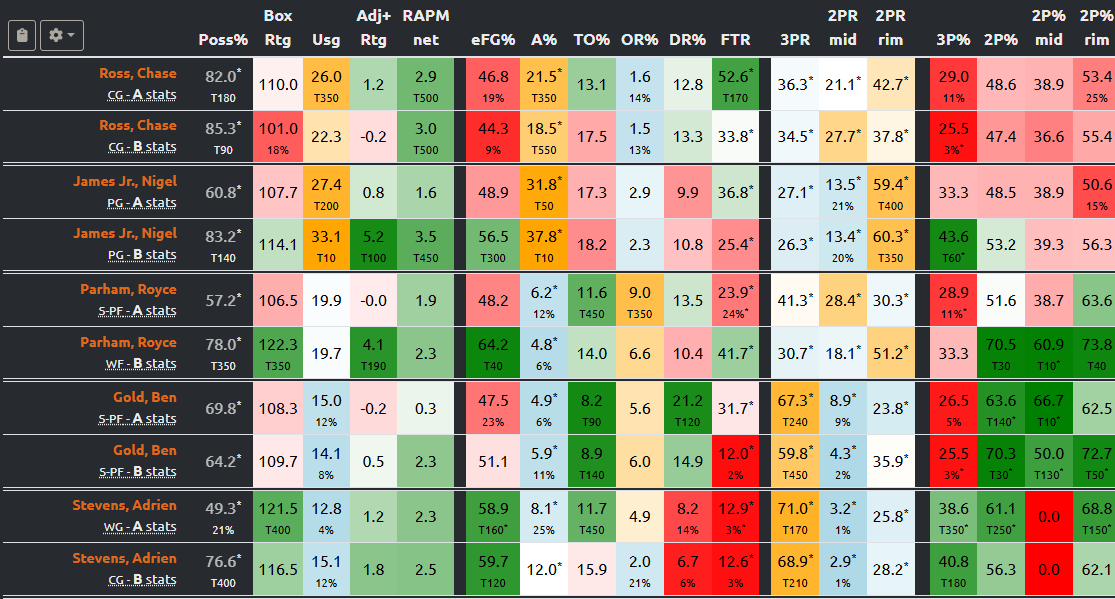
You can see that his stats have jumped significantly in almost all areas.
% of Poss: 60.8 -> 83.2
ORtg: 107.7 -> 114.1
Usage: 27.4 – > 33.1
RAPM: 1.6 -> 3.5
Put that all together and it tells us Nigel in playing in significantly more minutes, being given much more responsibility, becoming way more efficient, and doubling his on court impact. If you watch his first few games, he shows lots of flashes but doesn’t have nearly the consistency nor the court tilting presence he’s consistently displayed the last 2 months.
And that makes perfect sense, he’s an undersized a true freshman playing at the high major level and trying to simply adjust to the speed and athleticism. Then he gets handed the reigns in game 4. That’s a lot for anyone. But to his credit, he was able to take some of those early bumps and blossom into one of the best freshmen in the country.
Royce Parham isn’t exactly the same, as he already had a rotation role last season, but in 2025 this season, he had muted impact in relatively limited time. It was quite disappointing to see someone we were banking on taking that leap come back looking almost worse. But once he was given the starting spot and saw his minutes explode, he has been a dominating force.
This is from a month ago, so the stats may be outdated, but only because he’s gotten even better than he was in the start of February.
And while Damarius Owens belongs on a tier below Royce and Nigel (and Adrien), his emergence as a reliable contributor has been quite beneficial on a team loaded with players and bereft of excess talent. Check out the bench stats with that same 2025 v 2026 split. Only he and Michael Phillips have seen their playing time increase, but unlike Phillips, his minutes are now bringing positive results.
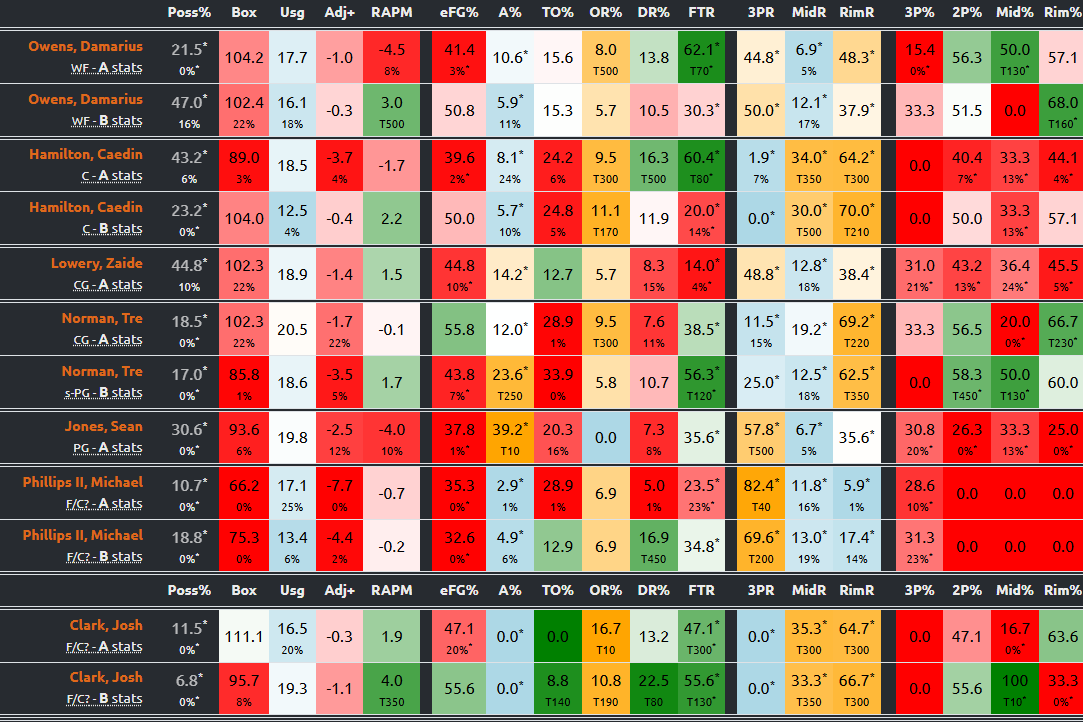
I had also written about him a few weeks back, but missed touching on the most important part.
Wholesale team improvements have more than just 3 causes, so don’t mistake the incoming transition as a definitive open and shut case. But in the big picture, the minutes and lineups were optimized for better players, and those players themselves began to play better with additional experience.
Have the Xs and Os changed?
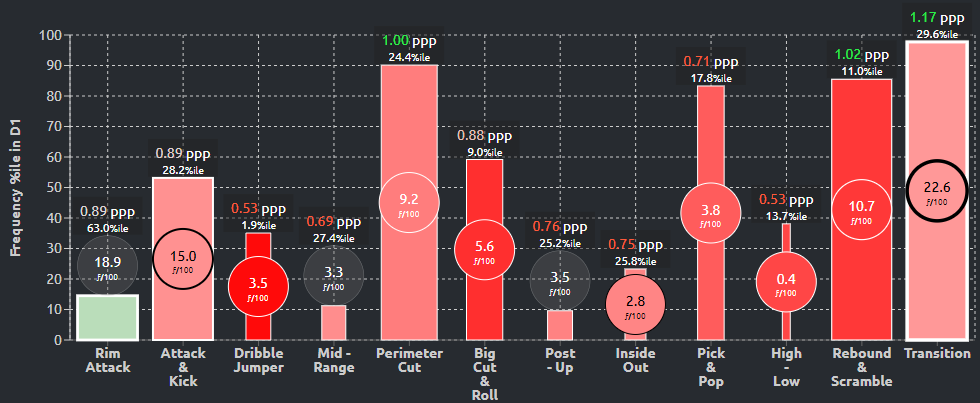
One other point I’ve been asked a few times is has there been any style changes, or is the team basically doing the same things it had previously done, simply with better results. Once more, we can look to Hoop-Explorer for these kinds of questions.
In 2025, transition opportunities (22.6), rim attacks (18.9) and drive &kick (15.0) were the 3 primary sources Marquette’s offense initiated plays. The height of the bar tells you how that volume compares nationally, while the color of the bar tells you how it compares in efficiency, compared to D1 for those play types. All that red confirms what you already know, MU was inefficient everywhere on offense.
Now compare the top (2025) to the bottom (2026)
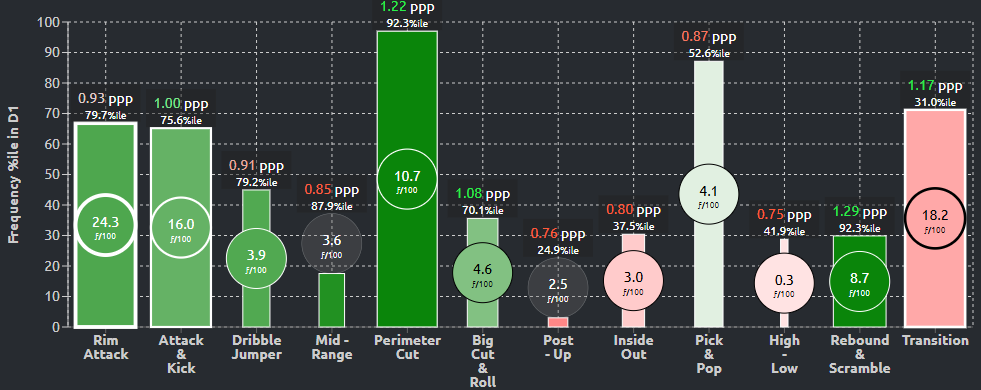
In 2026, rim attacks have become the primary source of offense, making up just under a quarter of all possessions, up 5.4, while transition opportunities have gone down by 4.4. But everything else looks quite stable. Oh yeah, and the green has mostly replaced the red.
So what we can take away is that although the pace has slowed a bit as shown by fewer transition possessions, the offense has pretty much remained the same framework, with much better results.
One other place this is notable is the much improved finishing at the rim. I wrote at length and Tweeted often about it in frustration.
But thanks to Royce and Nigel, and improvements for Ben and Damarius, we’ve seen a huge leap on finishing at the rim, from 53.4% to 61.1%.
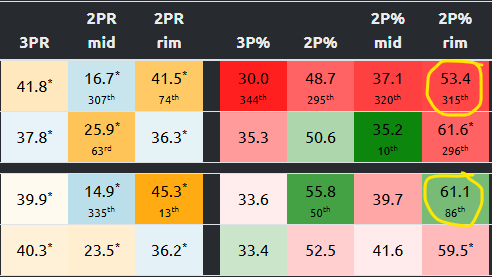
Marquette still isn’t a great shooting team from 3, but with the slight improvement there, and the major improvement at the rim, the offense has become at least competent.
Is this sustainable?
The reason I’m 1,500 words in and still writing isn’t that I love to be verbose, it’s that these changes have completely upended the complexion of the program going forward.
In the bleakest parts of the season, when I honestly thought Marquette might go winless in Big East play, it was difficult to see any way out of the darkness without wholesale roster changes. Sure Nigel was already fun and Adrien had potential, but they weren’t necessarily all-league type talents and there was very little hope growth would change that. But with emergence of Royce and DO, along with the leaps taken by the two freshmen, it’s not difficult to see how a few additions could propel Marquette near the top of the Big East and into the NCAA Tournament next season.
Nigel is a generational talent. He’s the first freshman since at least 2008 to play over 60% of minutes in Big East play while maintaining a usage rate over 30%. Oh, and he also has the highest ORating of the 15 previous true freshmen with usage over 25%. In him you have a foundational building block who not only makes your team better, he can do crazy things on the court that set the nation abuzz.
Royce Parham has been playing at an all-league level offensively for just under 2 months. Adrien Stevens would be getting 2,000 word deep dives every other month from me in just about any other season, if it wasn’t for Nigel, and has become a 2-way staple.
Those 3 are young, which means still have potential for significant growth, but experienced, which means you can rely on replicating most of the results we are seeing in subsequent years. This is a core that has huge potential. And it isn’t just their individual stats doing the talking. The underlying team metrics, as well as the improved record once these 3 started receiving max minutes tells us as much.
But 3 players does not a team. Chase and Ben have been underwhelming this season, compared to both past performance and preseason expectations, but they still have been in Marquette’s top 5 for impact and playing time. Losing those 2 may not feel like a huge loss, but I don’t think Marquette has anyone already on the roster that could produce their output next season without an absurd, Kolek-like jump (which almost never happen and should not be expected).
And that’s where Shaka’s surprising report last week about looking for answers in the D1 transfer portal makes this all the more exciting.
Running it back next season with the same players plus the new faces (freshmen and redshirts) probably wouldn’t be a catastrophe, but it also would not be close to a success. Being the 60th or so best team feels great when you’ve been the 145th best team for a prolonged stretch, but it isn’t a goal in and of itself. The goal is banners and deep runs.
What the core has shown this past 2 months is that it can be the backbone for a return to excellence. It plays well together and has further upside to be tapped, particularly on the defensive side. Shaka gave these 3 the keys this calendar year and that bet has paid off.
Pair this foundation with a rim running big and a secondary creator/ball handler that can have an immediate impact, and now you don’t have to rely on potential or give impact roles to players that might not be ready for them. If any of the new guys or returnees surprise and are ready, more depth and better players is a great surprise to have.
Conclusion
A good 14 games after an abysmal 14 games isn’t going to change the way we ever look back on the season. And heck, it doesn’t take a negative Nancy to see Marquette drop the last 3 plus the opening night of the Big East Tournament, to cement one of the worst Marquette seasons of all times.
What these 14 games have done is reinforce the principles of the offense can and do work. The Big 3 are talents you can build around. A few incoming transfers can use this momentum from the end of the season and help take the team to the next level.
Make a one-time donation
Choose an amount
Or enter a custom amount
Your contribution is appreciated.
Donate


 Paint Touches
Leave a comment