If you follow me on Twitter, you may have noticed that I keep missing big chunks of Marquette games this season. You see, I play soccer on a 30+ co-ed league on Saturdays and a 40+ men’s league on Thursday, and I’ve been unlucky in how our schedule has shaken out, overlapping with MU’s first halves a few times already. Seeing as I hate working out and these games are the only times my body gets any sort of activity, I think missing an MU half or two is justified.
I also love it. I’ve been playing soccer my whole life and got lucky to fall in with a great group of teammates. We get to kick the ball around for an hour, then grab a beer and laugh at the other old guys making fools of themselves in the next game.
But the biggest reason? I’m kinda good at it. I’m the goalie, and when you’re playing with “old” people like me, a goalie that still has a bit of life left in their legs and doesn’t mind smashing into the floor repeatedly puts me in the upper echelon. But don’t mistake this for hubris. I know am not in fact “good” at it in any real sense.
Because I have earned a reputation in my older adult leagues, I will get asked to pitch in on a few other teams once in a while, including on some open league teams, meaning playing not against 43-year-old travel soccer dads, but rather 23-year-old former college players. And boy howdy does that make a difference.
Instead of racing out to win a 50-50 through ball, I get beat by 3 steps and easily dribbled around for a sitter. Instead of using a long throw to start a fast break, I get picked off and leave my defense out to dry. Instead of stretching to make a fingertip save on a wobbly knuckler, my wrist gets bent like a doorhinge on a relatively straightforward shot. The speed, power and overall athleticism gap turns a relatively “good” keeper like me into a below-average one.
And what exactly does that have to do with Marquette’s poor start to the season? Everything, I think.
Talent Gap
When digging through site after analytics site, watching video, dissecting play types, my grand theory of what has gone wrong this season starts and ends with something so basic it almost doesn’t merit writing about. I think Marquette’s talent level, the skill required to play basketball at a high level of Power 5 hoops, is significantly below not just what it’s been in previous seasons, but below that of its opponents.
I know that’s a broad statement, but the more games I watch, and the more soccer I play, it is more and more obvious, particularly on the offensive side.
When you watch top-15 teams square off, the level of shot-making is just night and day different from what we’ve seen from MU so far. They can hit open shots, sure, but they hit contested jumpers regularly. They make tough layups around the basket. They dunk the ball through traffic.
And yeah, as fans we often focus on our team’s shortcomings and there is a certain grass is greener mentality that permeates. But the numbers don’t have my bias, and they say the exact same thing.
Marquette’s offense the last 5 seasons has revolved around creating situations where you get 2 players on the ball and find the open player. It doesn’t take midrange shots and wants to have everything come from the rim or from 3. It’s an analytically sound strategy that has put it in the top-35 each of the past 3 seasons. But on KenPom this season, Marquette currently ranks 93rd, which would make it the 2nd worst MU offense in the last decade.
One of the biggest reasons why is it can’t make contested jumpers. It is literally the worst team in the country, per Synergy, at making contested spot-up jumpers, ranking 365th out of 365 teams scoring .46 PPP.

If you’d rather see it in regular 3pt% terms, Marquette is currently shooting 15.6% on catch and shoot 3s. That’s absurd.
Normally when you get such an outlier of a number (only 5 teams this season are below 20%) on a smaller sample, you chalk it up to shot variance and say they will start falling at some point. And yeah, I don’t think Marquette will stay below 20% all season on contested spot-ups. But I do think we have a large enough sample from the players that take a majority of MU’s 3s to say it won’t ever be good there, and that it will remain near the bottom of not just the league, but all of Division 1.
Ben Gold is currently at 20%, after shooting 22.8% last season on these shots. He’s taken the most (20) so far.
Zaide Lowery is shooting 6%, after shooting 33% last season on these shots. He’s taken the 3rd most (16) so far.
Royce Parham is shooting 8.3%, after shooting 32.1% last season on these shots. He’s taken the 4th most (12) so far.
Chase Ross is the only one with a a positive track record and he’s currently at 26.3% after shooting 42.6% last season. He’s taken 19 attempts, 2nd most on the team.
Yes, players can improve over time, and that fact is baked into roster evaluations, but at some point, there is not enough regression to the mean coming. In the best of cases, this Marquette team has a bunch of mediocre to bad shooters (and only 1 Chase Ross) and expecting significant in-season progression is a fool’s errand.
Rim Ruh Roh
This is the part where anyone looking at the screenshot once more would note that Marquette is actually doing really well on unguarded shots, both in terms of making them and selecting when to shoot, as a majority of MU’s spot up shots so far this season have been the open kind. But the issue with this strategy is that getting unguarded shots is much more difficult against high major opponents.
The Oklahoma game was the first time Marquette took more unguarded shots (17) than guarded ones (5) against a non-cupcake. It’s also the best offensive performance by a significant margin, of its four losses. It should not be surprising to find out OU also has the worst defense MU has faced, ranked 142nd. Which is all to say, there aren’t going to be many games left this season where this MU team will get so many more open looks on spot ups compared to guarded ones. It has to make those tough ones.
But this is a whole lot of talk about what amounts to 40% of Marquette’s shots. Being a bad 3-point team is survivable, but when you combine that deficiency with Marquette’s inability to convert at the rim, you get why there is so much consternation about the team through 1 month of play.
Using the CBB Analytics database, Marquette is shooting 45.4% at the rim in its 4 losses this season, which is 17.2% below the D1 average at the rim.
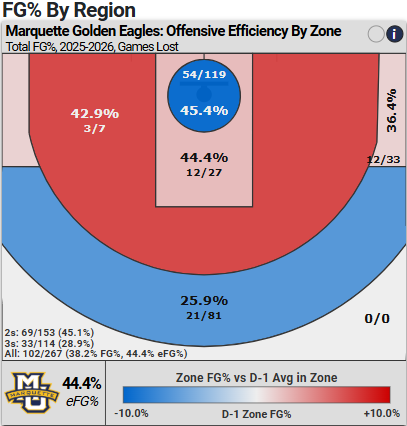
Against Q1 and Q2 opponents, here’s how Marquette has stacked up shooting at the rim the last 5 seasons.
2026: 45.4%
2025: 62.2%
2024: 60.0%
2023: 65.8%
2022: 60.4%
You don’t need to understand advanced math to see the new, glaring problem.
Marquette can’t hit contested 3s. And it also is a sub-300 team at finishing at the rim. If you can’t do either of those, there isn’t much left to do on offense. And you become an incredibly easy team to defend.
Big Problem
And trust me, there’s so much room to point fingers here. It isn’t one player or one play type or even one bad game that is making the numbers at the rim so ugly.
But we do have to note that Marquette’s big men have been particularly poor in an area where big men are supposed to thrive, at the rim. In the 4 losses, the bigs have combined to shoot only 15/37, 40.5%. And they have all been equally inefficient.
Ben: 4/10 (40%)
Caedin: 5/12 (41.7%)
Royce: 6/14 (42.9%)
Josh: 0/1
The accuracy isn’t the only issue, either. Having your big men only take 37 combined shots at the rim in 4 games, only 31% of total close shots are coming from them, is untenable. It’s both a volume and efficiency issue.
And to bring it back full circle, it’s a talent issue and it is glaring when the opponent steps up in ability.
When Marquette’s bigs are facing weaker teams, they do look great at the rim.
Ben: 5/6 (83.3%)
Caedin: 9/13 (64.3%)
Royce: 8/11 (72.7%)
Josh: 7/15 (46.7%)
Unfortunately, Marquette doesn’t play in a low-major conference. The Big East may be down again this season, but it will still be significantly better than the Little Rocks and Southerns of the world on a nightly basis.
Doom and Gloom?
Why yes, have you not read the first 1,500 words? Talent and skill isn’t remedied overnight. And it isn’t usually remedied in season. With an offense that is deficient at the 2 things it aims to do, the only solution is to mitigate that deficiency on the other end.
And, well, Marquette’s defense is also not very good.
I’ll give you one last stat to tie it all together. CBB Analytics allows us to split up stats not just by wins and losses, but by how a particular possession starts. So for example, if you ever wondered how Marquette’s defense fared after it made a bucket compared to when it missed a field goal, we have that exact number.
In its 4 losses this season, Marquette has actually played decent defense when it has time to set up after a made field goal. Per that site, MU is giving up .93 points per possession after it makes a bucket, which puts it in the 80th percentile nationally. However, when opponent start their possession off a defensive rebound, so a rebound on the other side of the court, they are scoring a whopping 1.35 PPP, making MU the 6th worst defense in the nation. One last time, these are only 4 game samples, there is quite a bit of variation expected, but those 90 possessions match the eye test.
On Friday, when Marquette couldn’t buy a bucket midway through the 2nd half, it felt like that frustration and uncertainty boiled over on the defensive end as well, and Oklahoma began to score at will. In only 7 possessions, Oklahoma turned a 12-point deficit into a 2 point margin. Marquette had a 6+ minute field goal drought in that same stretch, seeing that double digit lead turn into a 3 point deficit. It got good shots, yet it could not buy a bucket. And well, you know the rest.
I have always bought into process being greater than results. If you have a good system and take good shots, eventually the math will work out in your favor. But I can’t make that argument this year.
Marquette already beat all of Maryland, Dayton and Oklahoma in Shot Quality this season. Some might argue that’s bad luck and take it as a sign to keep the faith on an inexperienced team getting its feet wet. Me? I’m not looking at what the final score should have been. I’m looking at the PPS, point per shot number. Oklahoma had shot makers. It may have taken “worse” shots, but the people taking them were more skilled.
I think the system works fine. I think the offensive identity is excellent long term. But no matter what that system looks like, no matter how high quality the shots are measured as being, if you consistently miss them, it makes it incredibly difficult to win.
Last stat I promise. You want to know why I so confidently proclaimed that Marquette is easy to defend (other than the 15 stats I threw at you)? No team in Division 1 has faced as much zone as MU. Per Synergy, opponents use zone 35% of possessions against them. Teams that rarely use zones feel emboldened to do so.
Oklahoma came into the game having played 1 possession of zone all season. Against Marquette, it played 20 possessions. Worst of all, Marquette only scored 10 points in those 20 possessions.
Yes, put a guy at the throw line. Yes, move the ball more than just playing hot potato on the perimeter. Yes, don’t settle for 3s.
But just as I’m not going to magically turn into Manuel Neuer by playing in the open league soccer games more often, I’m not expecting to see dramatic upticks as the competition intensifies. It doesn’t have the talent to do so.
May I be proven wrong.
Make a one-time donation
Choose an amount
Or enter a custom amount
Your contribution is appreciated.
Donate


 Paint Touches
Leave a comment