Last season the NCAA introduced WAB (Wins Against Bubble) as an official metric on the NCAA Tournament evaluation sheets, and we used that opportunity to nerd out on it. And since it’s only growing in prominence, we are back at it, trying to use WAB to determine which Big East teams have the most difficult non-conference schedules, based on Bart Torvik’s projections.
If you have never heard of WAB, or simply need a refresher after a long offseason, I’d recommend rereading the full intro from last season: https://painttouches.com/2024/09/05/who-has-the-toughest-non-con-schedule-in-the-big-east/.
If ain’t nobody got time for that, here’s a quick summary:
For any given team, in any given game, the projection systems like TRank and KenPom will have a predicted win probability given an opponent and location. For example, Marquette will open the season at home against Albany this November. Torvik, which ranks Stony Brook 318th in the country, gives MU a 97% chance of winning that game. But that doesn’t matter for WAB. What matters is how an “average bubble team” would do, and TRank gives an average bubble team a 96% chance of beating Stony Brook at home.
So if Marquette does end up winning that game, it will only earn .04 points, since it’s a given most tournament quality teams will win that game. However, if it does lose, it loses .96 points, as losses truly matter for WAB, not just wins. The penalty for losing to a cupcake is severe.
Ok, got that?
So who has the toughest schedule?
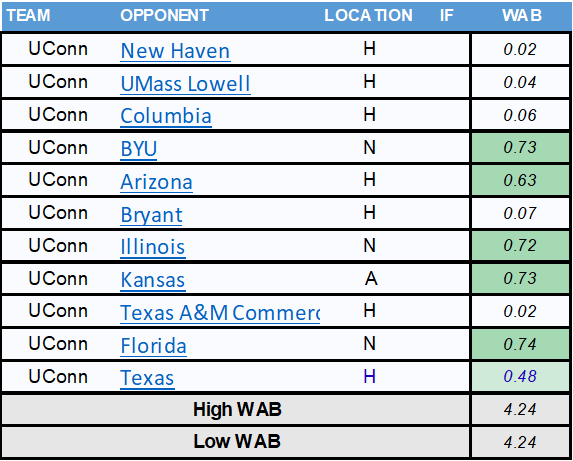
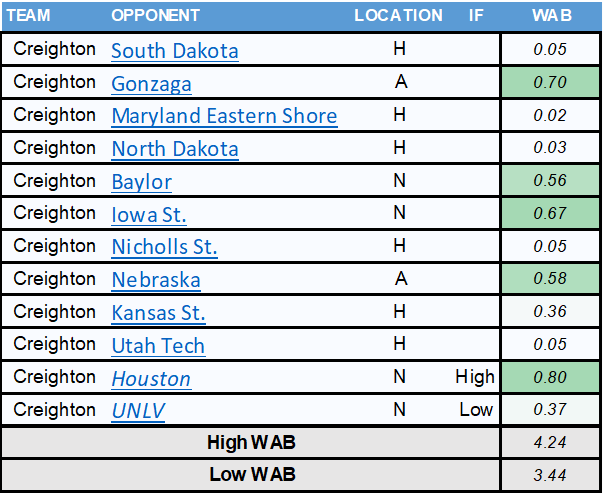
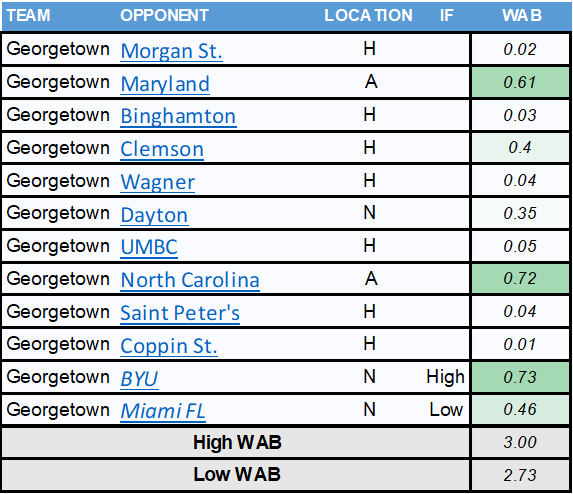
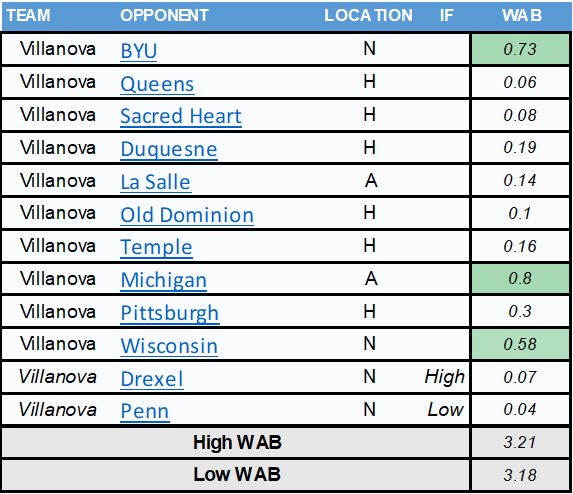
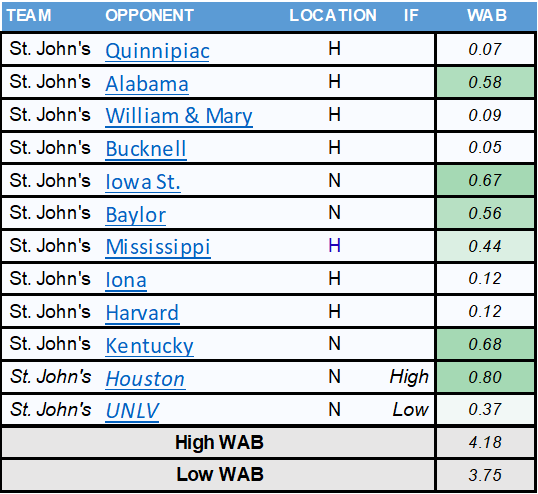
As of early October, it’s UConn, with Creighton and St. John’s possibly coming close if their tournament matchups break correctly. Remember, WAB here is simply a sum of the induvial game win probabilities an average bubble team would have if they win every game. So if Marquette goes undefeated, it would be 3.68 points better than what an average bubble team would be expected to get.
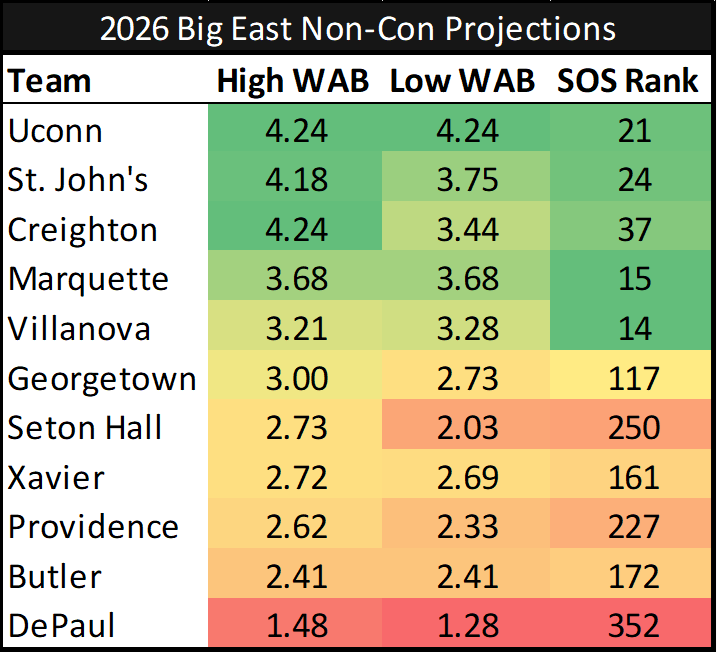
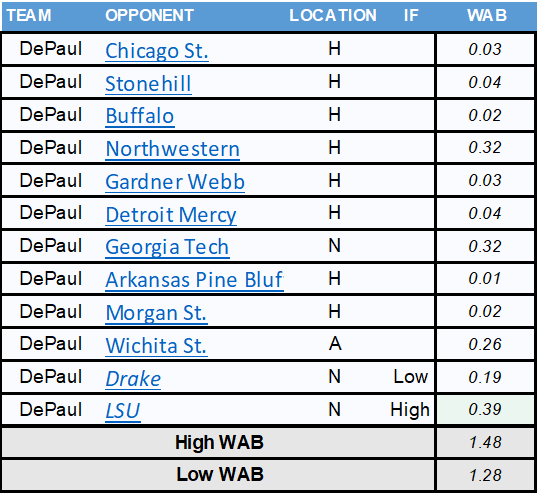
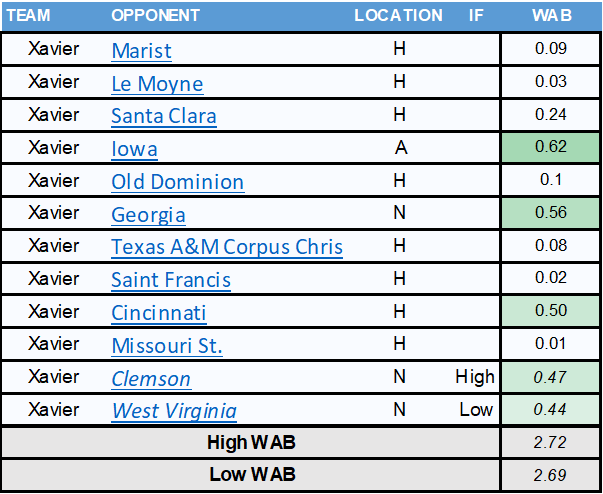
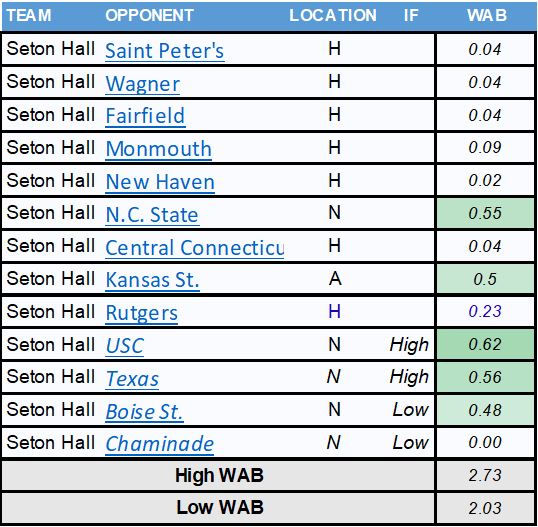
Using this undefeated benchmark, the top-3 plus Marquette have very difficult schedules, with Villanova and Georgetown also being in the good tier. Hall, X, PC and Butler are acceptable, falling between 2 and 2.73. It’s really only DePaul that is shocking me. Their schedule has the lowest WAB potential of any Big East team I’ve tracked in the preseason the past 4 years (with Georgetown at 1.60 in 2024 being the 2nd worst). Here’s their game by game breakdown.

What does that mean? That DePaul has almost no margin for error. Any combination of 2 losses will give them a negative WAB score going into Big East play. Playing at Wichita State is a decent enough challenge, but using Torvik’s WAB projections, it’s actually worse than playing Dayton at home. Bad nights happen over the course of the season, but a schedule like this magnifies the importance of those bad nights, because you don’t get a chance to make it up later on. Of course, this only matters for NCAA purposes, but if DePaul were to be sniffing around a bubble spot (which I do think is within reason), this non-con schedule might haunt them.
Why is SOS so different?
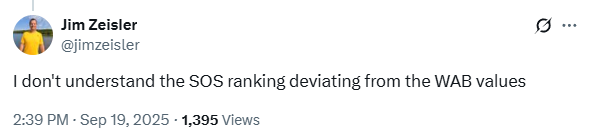
Jim on Twitter had a great question when I put up the WAB chart, wondering why we see deviations between SOS (Strength of Schedule) and WAB. The biggest reason is that current SOS rankings are incomplete. Any team who is in a bracket-type MTE (Holiday Tournament) doesn’t have a set opponent yet for at least 1, possibly 2, games, so teams may be missing some of their toughest opponents in the way SOS is calculated at this point in time.
But the answer I gave last season still holds up:
For starters, strength of schedule is an average, and averages can be easily fooled by extremes.
Let’s take UConn from last season as an example. Although they played some elite competition both home and away, they had a good chunk of cupcakes that obliterated their strength of schedule.
Northern Arizona: 318
Stonehill: 357
MVSt: 362
Manhattann: 336
Pine Bluff 329And as a result TRank had the Huskies with the 142nd best non-con SOS, 10th out of 11 teams in the Big East. Almost 100 spots behind DePaul. Yes, the math is correct, but it simply doesn’t fit the logic of what we are trying to accomplish. They played 4 top-15 teams, all away from Storrs. An average here does a disservice.
WAB is just a much more accurate way to measure quality as a whole.
How do projections hold up?
Of course, we know teams will not go undefeated, and with WAB that means you lose points in a defeat. And boy did the Big East ever do that last season.
Here’s the 2025 season table that includes both the projected WABs as well as the actual WABs. Again, a score of 0 would mean you had results like that of a bubble team. And last season, only 2 Big East teams posted positive scores (Marquette at +2.2 and St. John’s at +0.34. That’s really, really bad.

And here is the same table, but using 2024’s results.

I bring up both seasons to highlight a very important idea. Just because you have a difficult noncon schedule doesn’t mean it’s a good schedule. Take DePaul as an example once more. In 2025, they had a pretty poor projected noncon schedule projected to be worth 1.95 WAB points. They weren’t amazing or anything, but mostly handled their business against the cupcakes, and ended up finishing with a -0.12 WAB, the 4th best in the conference.
Now look a the DePaul 2024 number. That had a projected WAB value of 2.91, which is in the good to very good range. But they not only lost their quality games, they also lost some of their buy games, going 3-9 in the noncon enroute to a whopping -5.09 WAB.
All of this is to say, great schedules don’t simply have a litany of tough opponents, but rather meet teams where their expected level is at.
WAB Schedules
And in case you haven’t clicked over to Bart Torvik but are interested in seeing the game by game WAB breakouts, click on the images below.



Make a one-time donation
Choose an amount
Or enter a custom amount
Your contribution is appreciated.
Donate


 Paint Touches
Leave a comment