When you lose 3-straight games, you don’t really need deep analytical analysis to know something is wrong. Yes, these are the 3 best teams in the conference. Yes 2 of them were on the road. But the results speak for themselves, and they say Marquette isn’t playing well enough to beat good teams.
The more concerning part, for me at least, is not that Marquette lost 3 games in a short period, but rather, these 3 losses were a culmination of a longer stretch of less than stellar play.
2025 slide
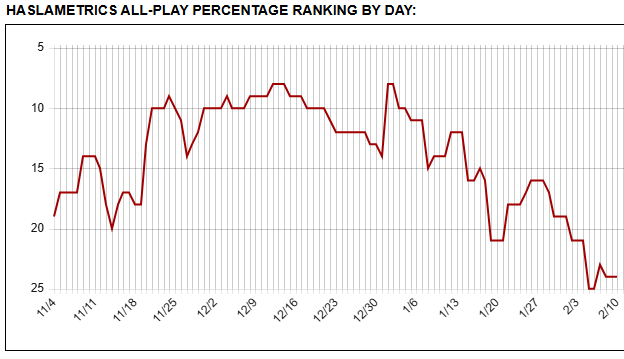
Looking through a few ratings sites, you can see that it’s not a 1-week blip. If we focus simply on the 10 games in 2025, you can see that the quality of play had been lagging before the current losing streak.
Haslam Metrics has a great visual representation of this, where you can see Marquette went from a top-10 team to one closer to 25.
Using Bart Torvik’s site, Marquette has a barthag of .8217 since Jan.1, which is 54th in the country in that time frame.
On KenPom, Marquette has fallen from 8th on January 1st, to 23rd today, a 15-spot drop that has seen its adjusted efficiency margin drop by -3.04, which is worse than over 300+ teams in that time frame. That’s not to say KP thinks MU is a bottom-300 team, simply that Marquette’s change in play from that day forward is in the bottom tier nationally.
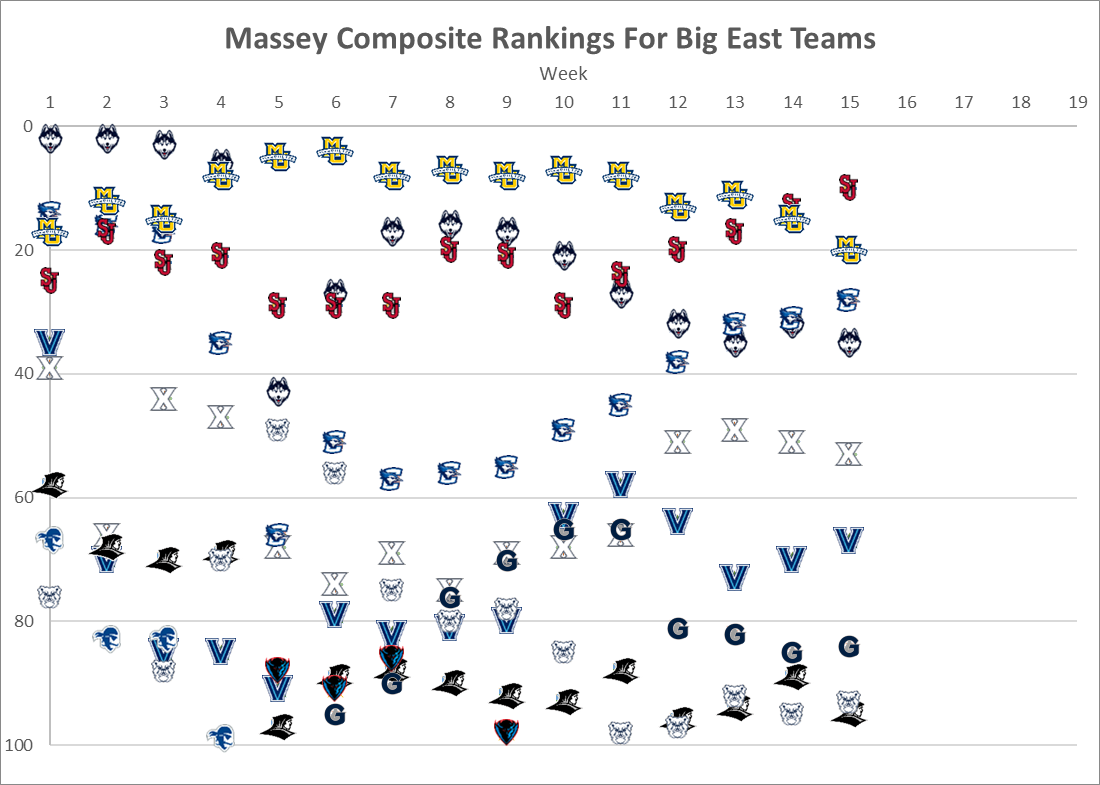
If you don’t want to trust 1 particular site, an aggregate on Massey’s site paints a similar picture, where St. John’s has overtaken Marquette as the top team in the Big East.
But why?
Man, if I had that answer I’d be calling up Shaka and his staff this moment. I don’t have any silver bullets, but the publicly available data gives us a pretty good picture.
Marquette is missing too many shots and opponents are making too many.
While that is incredibly reductive and not helpful, it’s simply a glib way of noting Marquette is losing the effective field goal battle pretty decisively of late. As a reminder, effective field goal percentage (which weights for the added points a 3-point make provides) is by far the most important of Dean Oliver’s 4 factors, making up about 40% of a result on its own. (If you’d like to learn more about this, this 17 year old post is still biblical, in the sense that it provides as much value if not more, than when it was written.
For the season, Marquette’s eFG% on offense is 51.8%, which is 134th in the country. However, if we only look since January 1st, that drops to 48.6%, 272nd. On defense, Marquette relies more on turnovers than being an elite shot defending team, but even here, Marquette is down to 225th in the calendar year.
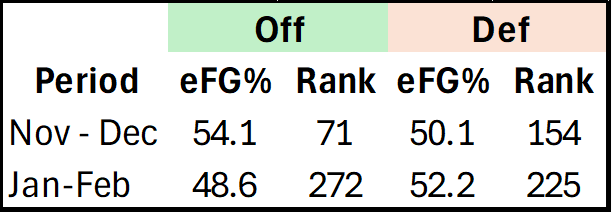
So Marquette has gone from being a +4.0% in eFG margin, to -3.6% which puts an extreme amount of pressure on Marquette being an elite team for turnovers on both sides, as well as adding even more value to rebounding.
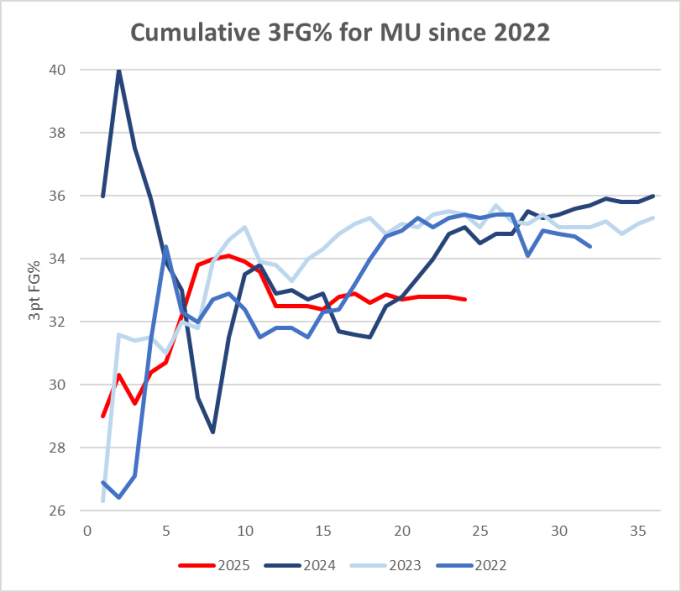
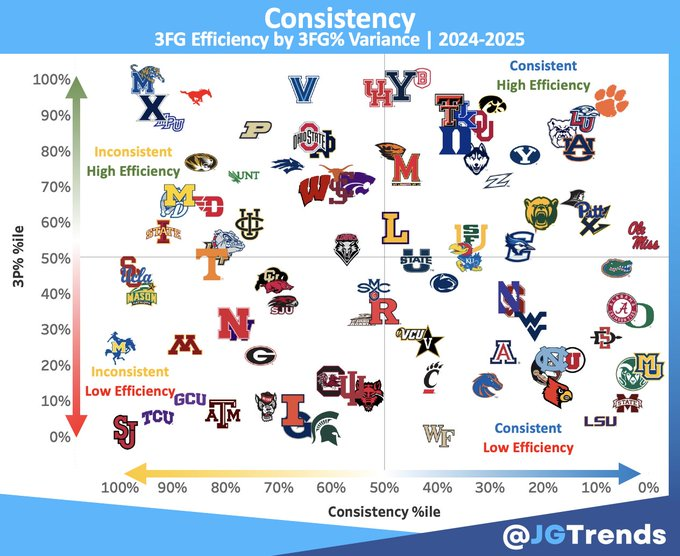
Looking one step deeper, one of the clear issues (which I wrote at length about last week) is Marquette being a high volume 3-point-shot taker, but a low volume 3-point-shot maker.
This chart makes it so clear to see just how far below the past 3 seasons Marquette’s distance accuracy currently is.
And this chart for JGTrends puts into perspective what this high volume, low efficiency combo looks like compared to other top teams.
I was interested to gauge if the types of shots MU got without Kolek and Oso might be part of the cause of this, and while it obviously has an impact, I don’t think that’s the main issue.
Using Synergy’s platform, I separated the catch and shoot 3s, which are more valuable, and the dribble jumper 3s, which have a much higher degree of difficulty. While Marquette is taking more dribble jumpers than the past to years, it’s not even an extra shot a game (5.5 vs 5 last season).
The biggest change is simply the drop in percentage made, down to 26.5%.

Yes, catch and shoots are below previous years as well, and .045 PPP is not insignificant when we’re talking about 700+ possessions over a season, but in an average game, that’s only about 1 point a game. The drop in dribble jumpers is particularly notable when you break down who is taking these difficult shots.
Kam Jones shot 41.1% on dribble 3s last season on 56 attempts. This season he is only shooting 22.7% on 46 tries.
David Joplin shot 26.7% on 30 dribble 3s last season, a number that hasn’t budged in accuracy but exploded in volume. Joplin is currently shooting 26.9% on 74 dribble 3s, a 147% increase. That’s not ideal.
It’s easy for me to look at Excel and make proclamations like, don’t take low quality shots, this isn’t meant to assign blame. Joplin went from the 4th option most possessions on offense to the 2nd, with a greener light and more responsibility. It makes sense he’d have a few more grenade type end of possession heaves. But having seen the career pattern, it does make sense to lessen the quantity of 3s he shoots off the dribble in most non-endgame situations.
Bench help?
If you are tired of bad news, I got some good news for you. The bench help we have been praying for since November seems to finally be here, particularly in the form of Royce Parham and Zaide Lowery. Those 2 saw 20+ minutes in back to back games for the first time all season, and more importantly, are having a very positive effect.
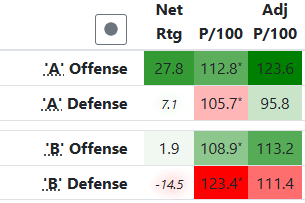
It’s risky to rely on Net Rating data over a small sample, as a few makes here or there makes a drastic difference, but that caveat aside, Parham and Lowery have combined for 196 possessions over the last 5 games, and Marquette is playing like a top-15 team in that time frame with one or both on, compared to a sub-140 team when neither of them are in.
Watching Royce stay on the perimeter with Ashworth and manhandle the Creighton front court was something I didn’t think we’d see at all in his career, let alone by the middle of his freshman campaign.
Zaide’s 3 point shooting is shiny, but his aggressiveness attacking the basket on the bounce was not anywhere near his bag last year or even earlier this one.
Yes, Marquette still lost the last 3 games even if they played well, but as the season has not ended yet, these signals that we are witnessing 2 younger players bloom are more than enough to keep me excited the rest of February into March.
One last thing
You know the saying be careful what you wish for? In manifesting positive bench results, we may have accidentally zapped the talent of the starters.
No, I know it doesn’t work like that, but it’s imperative to see this chart from CBB Analytics to understand what I’m talking about. Marquette has one of the best 5-man lineups in the country this season in its starters, with a raw net rating of +29.4 ranking in the 99th percentile.
And yet, look at all the red the last 4 games in the bottom right.
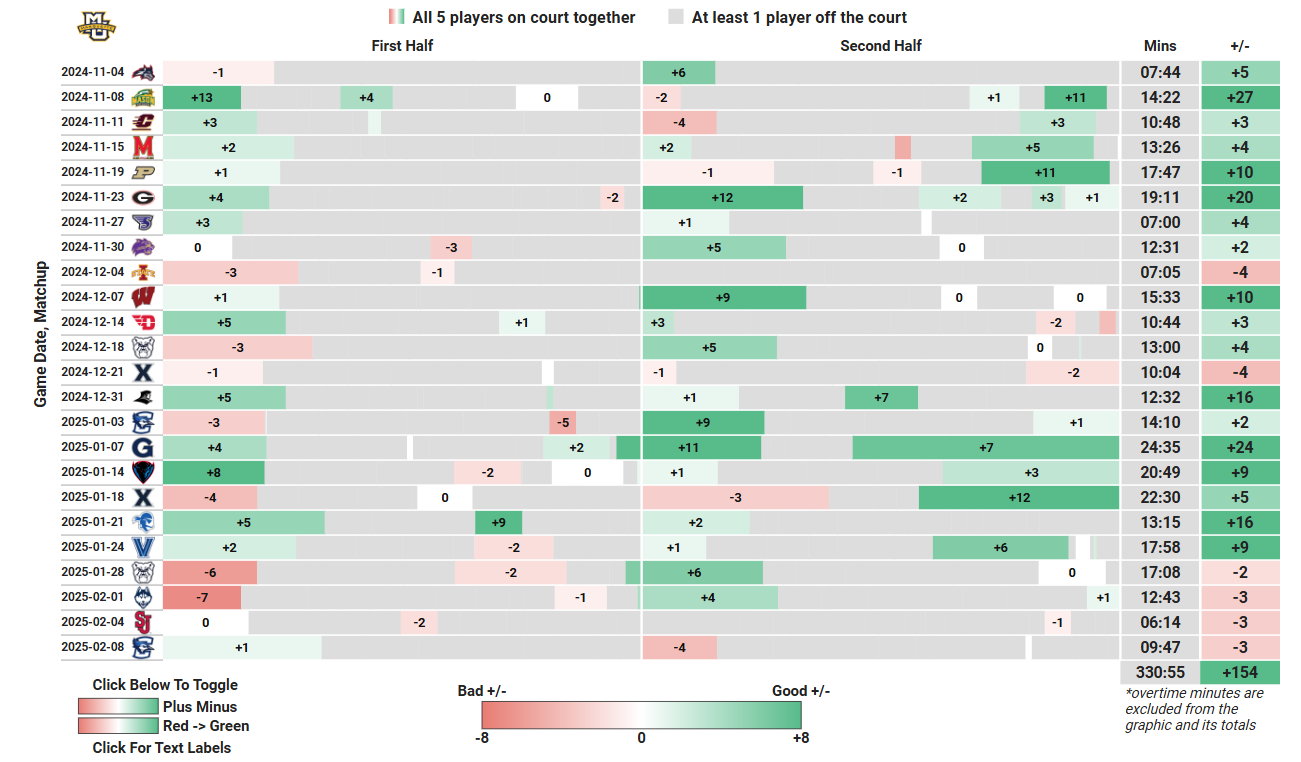
This chart tells us Marquette’s starters are -11 the last 4 games and posting negative variances only twice the previous 20 games. While there are 100 different reasons for this, I’m sticking with my worry from Jan. 8, overuse.
The new roles and increases in responsibility take a toll, and Marquette played an insanely difficult schedule putting, the most (hard) miles of any high major lineup in the country. At some point, you gotta pay the piper.
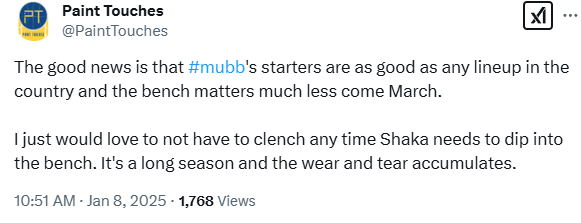
The good news is, I don’t expect this to continue all season. With the step up in play from Royce and Zaide, the starters shouldn’t need to log 25+ minutes together each game, and the talent is still there. We have seen them play at the highest level together.
Of course, the bad news is time is ticking. There are only 7 regular season games left, and physical issues don’t magically heal themselves when the calendar turns to March.
Me, I’ll continue to stay trusting a process that has Marquette ranked 7th in the country in combined offensive and defensive shot quality. Kam is returning to All-American form. At some point reversion to the mean will come from distance. There is too much history. Add in the reps and fresh legs from 2 reliable players, and there is plenty to hold on to if you still think, like me, this team is a 2nd weekend+ team.
Make a one-time donation
Choose an amount
Or enter a custom amount
Your contribution is appreciated.
Donate


 Paint Touches
Leave a comment