Although it feels like the world is ending while in the heat of the moment, my brain easily shifts into analysis mode after a loss, which helps to take some of the sting off.
In this case, watching Solo Ball knife each and every Marquette attempt to get back into the game made me despondent, but letting the freshness of that pain recede, I wanted to dive in to see what the data might be showing us, as it seemed like Marquette’s shooting has been underwhelming in Big East play.
Cold Spell or New Reality
Going into the season, I got to speak with Marquette offensive guru Nevada Smith and he told me flat out we’d likely see an increase in 3-point-rate this year, meaning Marquette would take a higher volume of their shots from beyond the arc than they had in past seasons.
“The guys that are going to play those minutes are high volume shooters, so we’re probably going to take more threes. I would expect our three point rate to go up just with the guys that are going to be on the floor. I think what it does do, from an offensive standpoint, is our spacing is going to be even better than than it was last year.”
And sure enough, Marquette is on pace to set a new school record in the KenPom era (and likely all-time) in 3-point-rate. It currently is taking 45.7% of it’s field goals from distance, compared to 41.2% last year, and ranks as the team with the 54th highest rate in the country. So like we were told, this team is not afraid to put up shots.
However, despite the process matching expectations, the results have thusfar not been as positive as expected. Marquette is shooting only 32.8% from 3-point range, the 2nd lowest hit rate for MU in the the last decade.
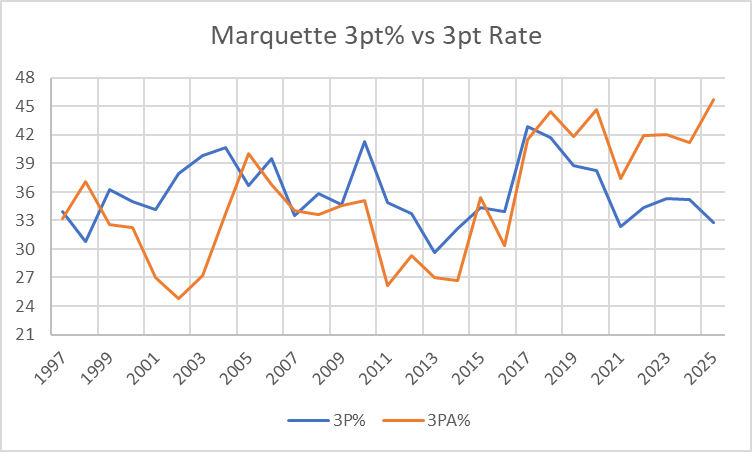
As you can see above, we’ve never seen a gap this large where so many shots are matched with such low percentage of makes in the Ken Pom era.
Now, this is the point where you might expect me to say it’s time for the process to be altered, and Marquette to become less reliant on the 3, with such futility in success. And you’d be wrong.
Unlike the past 2 seasons with Tyler Kolek and Oso Ighodaro helping to create for others in the half court, most of the creation falls to Kam Jones or drives by others. This only works well if there is space in the lane, usually going with some sort of 5-out offense.
And to date, the results have been good to great. Marquette averages 26.5 shots at the rim, per Synergy, most in Shaka’s tenure and 2nd most in the conference while averaging 1.20 points per shot, just behind the 1.23 of last season and 4th best in the Big East. So you can’t necessarily change a scheme midflight that got you a top-20 resume in the country and continues to yield quality, fruitful attempts where each shot is most valuable.
Furthermore, we have a decent sample to show that Marquette tends to improve its 3-point shooting as the season progresses. Check out the chart below.
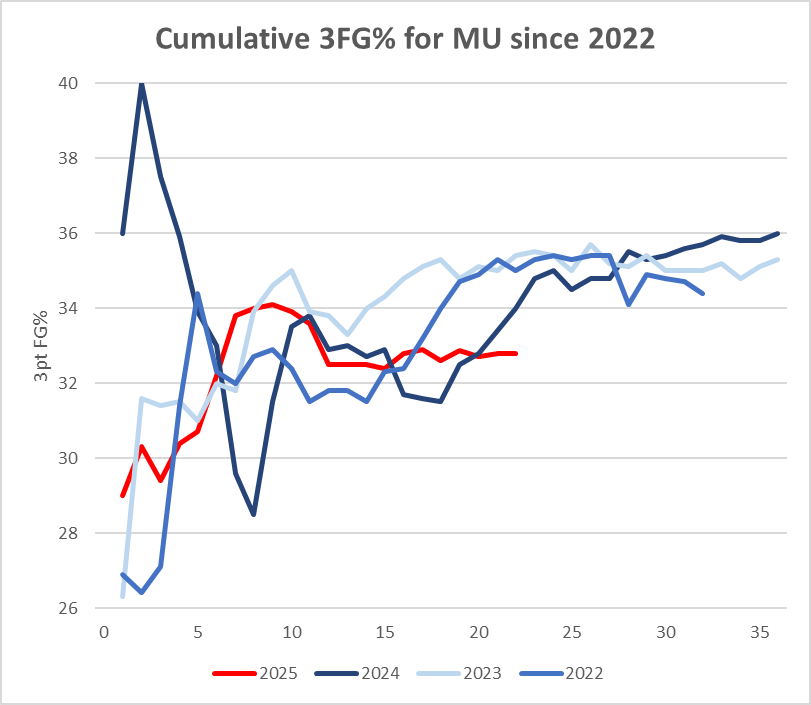
Sure, personnel has changed a lot, and 3 seasons aren’t a huge sample, but there is still a fairly established pattern to hold on to.
And one more thing, who is shooting and what kind of shots they are taking is also vital.
Shot Distribution
Marquette’s starters have taken 77.1% of Marquette’s 3s this season, and are shooting a respectable 34.2%. The bench has taken 145 combined 3s and are only making 28.3%, so right off the bat, you can see where some of the bench issues we have discussed come into play.
But looking into the starters further, it’s important to note the pretty huge gaps in results. Gold, Ross, and Mitchell have combined to shoot 37.6% on 218 attempts, with all 3 setting individual career bests in percentage both for an individual season and for the season as a whole.

But the red is glaring. Kam and Jop are both 4%+ worse this season than they are for their career, which is made more problematic because they have taken the most 3s this season, 55% of those taken by he starters.
The reason we like to use career percentage as a benchmark is that 3-point shooting is extremely fickle, and a 20+ game sample isn’t always a great barometer of true skill. Using their 4 year samples, we can say with confidence, Kam and Jop are good to great 3-point shooters, even if the results haven’t been there so far in this year.
But the season as a whole is much less of an issue, for me, than the results in Big East play. In nonconference, Marquette shot 33.9% from 3, which isn’t amazing, but was above average. In conference, they are at 31.9%, which is 253rd in the country.
And here is where Kam in particular has seen his numbers plummet. Whereas he was shooting a career best 41.2% in the noncon, he’s shooting a career worst 25.4% in Big East play, almost 16% points below where he was for the first half of the year.

This is not news to anyone that has been watching, but it has taken a huge toll on how Marquette’s offense works. Whereas he was utterly unguardable in the noncon, opponents no longer fear his shooting to the same extent. This isn’t meant to say Kam’s shooting woes are to blame for the current from, there’s plenty to go around. Simply, Kam is more important to this team than any MU player in recent memory, so his struggles are felt more acutely.
Type of shots?
I’ve seen others note that Kam’s new role is to blame for his shooting woes, and I’m not sure the data would agree.
Obviously, in his role this year Kam doesn’t have the same setup he’s had the past 3 seasons. He can’t simply load up and prepare for a Kolek kickout. He’s shooting fewer 3s per game than any season since 2022, down from 6.5 last season to 5.4 this one.
But in terms of spot ups (3s created by others and taken without a dribble), they are down much less than I would have assumed. He took 2.9 guarded spot ups last season compared to 2.3 this one. And he’s down from 2.1 unguarded 3s a game to 1.2. So yes, down about 1.5 shots a game from spot ups, but the efficiency on those is pretty similar.
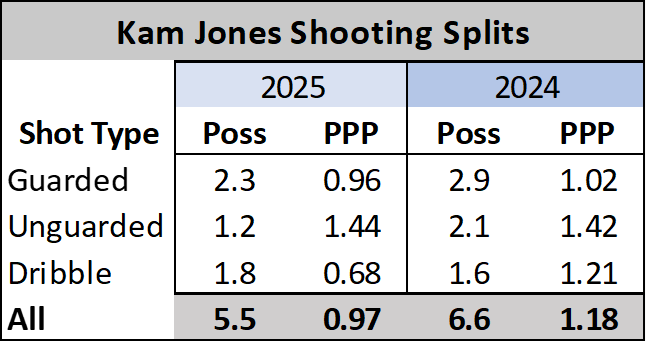
It seems dribble 3s are where Kam is really struggling, increasing his usage while seeing his accuracy plummet. He’s only shooting 23.7% this season on 3s taken off the dribble. And again, that was something he did extremely well before.
One thing I will note, even with Kolek manning the PG duties, Kam had an extended slump last season that he was able to pull out of halfway through Big East play. So it isn’t all just role based.
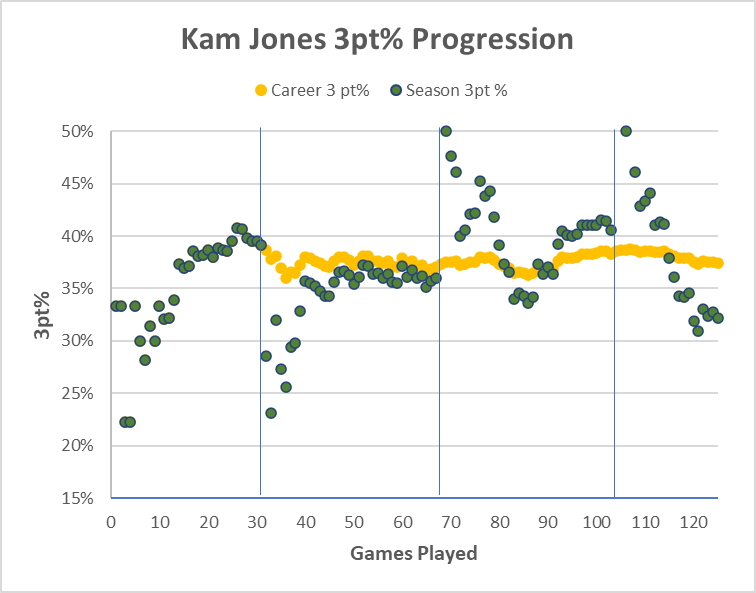
So what this tells me is the data would trend toward this being an outlier rather than a new normal. Kam did not all of a sudden forget how to shoot. He is not forcing up shots he has never taken before. And he’s gone through valleys before.
We saw Shaka Smart trying to get Kam to loosen up in the huddle against UConn, and tell him it’s ok to make mistakes. It looks like he’s pressing a bit, and letting misses impact the rest of his game.
So what now?
It is in turbulent times where trusting the process matters most.
I am not in staff meetings so I have no insight into what Shaka and Nevada and co. are taking away from this recent run of play, but from what I can see, from an offensive perspective, the opportunities being created are what you’d want. Plenty of shots at the rim, with a majority of your 3s taken in rhythm, by players with deep history of hitting at a high clip.
The results have not been there for a while, and that’s why it feels so dire, but that’s not to say the results will never be there.
Time will tell, but the good news is Marquette doesn’t need to hope on in season-growth to power this reversion. And it also doesn’t need to hope for an unsustainable jump. This isn’t Markus and Sam and Rowsey bombing teams from all spots, and it doesn’t have to be.
Getting Kam and Jop near their career average on similar shot volume would mean an additional 35 points in conference play. No, I know it doesn’t work like that, but the point is simply average play from 2 players would yield a significant change each game. Not to mention all of the additional benefits that stem from players playing with confidence.
Maybe it’s bias. Maybe it’s hopium. But I still think this Marquette offense has plenty left in the tank.
Make a one-time donation
Choose an amount
Or enter a custom amount
Your contribution is appreciated.
Donate


 Paint Touches
Leave a comment