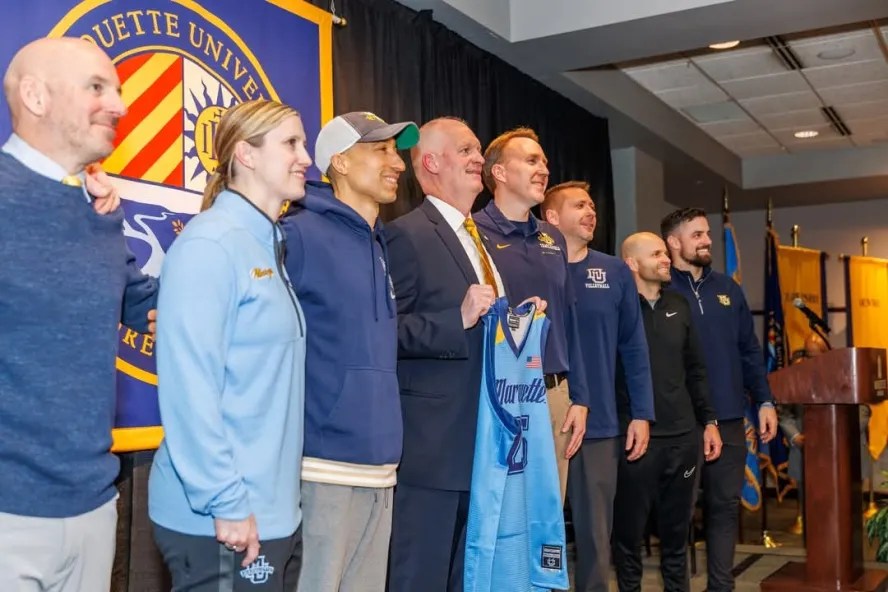
Marquette University announced the promotion of Mike Broeker from Assistant AD to Vice President and Director of Athletics on January 21, 2025, replacing Bill Scholl. Broeker has been at Marquette for 21 years, 18 of those as AAD, and has been managing day to day operations of the men’s basketball team, with a focus on external operations and revenue generation.
With the transition into the new role, Mike was kind enough to give us time to ask questions about his role, learning curve, and the breadth of uncertainty that currently awaits college athletics.
(Editor’s Note: The interview has been edited for length and clarity.)
Role Changes
Paint Touches: Having been at Marquette for forever, now you have a new title, new role, new responsibilities. How does your day-to-day change as an AD?
Mike Broeker: I think it changes in a number of ways. Number one, you have to widen your perspective. You move from whether it’s being a part of a leadership team to leading that leadership team. So you know, I’m going through that process now of trying to understand how do I redistribute the things that I worked on on a day-to-day basis. And then, where does my time have to be focused in terms of leading the department and creating an environment in which our people want to work and are excited to come to work every day. Then trying to understand, through my own bank of knowledge or learned skill over almost 3 decades in professional and collegiate sports, where can I make the greatest impact in terms of the work to be done?
PT: One of the questions that’s related to that is that you have run point on a lot of the Marquette basketball administration and strategy for the last decade across multiple coaching staffs, is that something you foresee continuing in your new role or do you think there’s going to be a replacement, whether it’s internal or an outside hire, into what you used to do for your day-to-day for basketball?
MB: You know, I haven’t given an enormous amount of thought to that yet. I think that part of that conversation has to be just sitting down with Shaka (Smart) and saying, what kind of support do you need from not just me, but from others in the department? What does that look like, right? And how do we continue to support this program and build the structures around it off the court to allow it to continue to grow, to be the championship level program? We need it to be, you know. Selfishly, I love basketball, so I’m not going to stray too far from it, that’s part of my balance. But that’s absolutely a conversation that he and I have to go through together because ultimately, all I want to do is create the environment that allows him to continue to do what he’s been doing since the day he arrived.
Financial Challenges
PT: And so then as you kind of think big picture, what would you say your top challenge is right away? And then what’s your top challenge over the next four or five years into the next decade?
MB: I think the challenge that’s creating all sorts of pressure on our industry is that running and operating at the elite level of college basketball is going to get more expensive with revenue sharing, if the House Settlement gets approved. So you know how are we going to absorb that? What does that look like? We have our own initiative going through on campus (strategic plan) 2031, where we’re trying to create some transformational change, and we’ve spoken within that. We have spoken specifically within that plan to how we transform athletics to not only grow and thrive, but be more sustainable for the university. So those things are really running parallel to one another. And we’ve been engaged in some of that work over the last six to eight months and we’re going to continue to do that. Within that there are 1000 micro challenges, but it all comes around the idea of we’ve got to find ways to operate as a business but never, never, never stray from our core responsibility, which is developing students through sport.
PT: How much can you plan ahead for and then how much do you have to react based off of the news that will come out in April and beyond?
MB: I think it’s a little bit like going through COVID where you have nothing to lean on in the past that can help you at least set some direction on where you’re going. So more than anything, what you have to do is have the humility to say at any moment’s time we may have to pivot. So we could build a great financial plan and something can happen and we have to have the humility to say, you know what, we have to pivot. We took that approach to COVID and the goal was to get kids back on the court and playing and. And that was not a straight line to do that. And so I think it’s the same, we have to look at our revenue streams to see how we can grow those. We have to look at, are there new revenue opportunities for us down in the Fiserv in the way that we produce our product? Or in the bowl, are there opportunities there for us to flex our configurations. We think there may be some lessening of (NCAA) restrictions around what you can do with jersey patches and things like that.
So we can contingency plan for those. We can understand what’s the valuation on those things. So we can have some line of sight on what revenue growth could be. And then we got to look inside our own department and say are we being as efficient as we possibly can with the incredible resource that the university is providing us, and then within that, and I talked a little bit about this last week, this is going to be important for all of a college athletics moving forward, what are the things that you can do great versus the many things that maybe we’re just doing good. And if we’re lining up our resource around those opportunities for greatness, does that give us the differentiation and recruitment of a student athlete or development of a student athlete or engagement with our donors and season ticket holders? So it’s really taking the opportunity to be more business focused, but never losing a line of sight on the most important thing we do, which is develop kids through sport. And, I’m obviously biased, I’ve been here 21 years, but I think our coaches and the administrators we have in the areas that are student facing do that better than anyone.
PT: There’s a general desire to cut costs across the university and athletics being part of that. How does that affect the expectations, then, that you have set for the teams? And for the athletic department as a whole.
MB: We haven’t really charted the path as to how we’re going to be more sustainable and more efficient yet. We’re considering a number of strategic measures now. I said this last week, we have to come together and accept our reality but not allow it to drive our future, right. We have the ability to shape our future. One of the things I’m trying to be most committed to is not just making assumptions cause I’ve been here 21 years, right? I want to see this department through the lens that I have now. I want to reengage with my teammates and ask some questions and get some thoughts that maybe they had not shared with me in the past given my role. And then really, I’ve done little of this right now outside of informally over the years with athletic directors around the sport of basketball, talk to the other directors in the league about how they’re thinking about things. I feel like in higher ed, we’re all going through the same challenges and if we can come together as a conference, we might be able to help create some solutions that makes sense for all of our student athletes.
Fiserv Opportunities
PT: I want to touch on one thing you mentioned in terms of Fiserv. So looking through past articles, I think the lease, unless something else has been kind of signed without public knowledge, expires either this year or next season.
MB: No, we’ve extended that lease. Without getting into particulars, it was a long lease with multiple options within it. We’ve already exercised one of those options and those guys have been terrific partners. We have had good conversations with Peter Feigin already about how can we help grow this together and they’ve been phenomenal in that regard.
PT: That’s good to know. And so then I did have another related question. I don’t know if you saw but Anonymous Eagle had a really nice piece last week about the the Fiserv concessions and how it seems like there is a limited amount of concessions compared to a similar size Bucks game for a weekend sell-out.
MB: I did see that and that we do not share in food and beverage, but we have a vested interest in making sure that Fiserv is healthy.
PT: So in that vein, are concessions something that you speak with with them about or have input on?
MB: They’ve been great partners and we’re constantly dialoguing with them about all things around the experience and, ultimately, they have to make the decisions that make sense for them. The question, and that’s a great one, that’s a perfect example, for us, of what it’s about. It’s asking, “are we providing an experience for our fans from the minute they leave their house to the minute that they go home that’s consistent with the value we put on that experience.” And I can’t speak to the differentiation between their games and our games, I haven’t haven’t been to a Bucks game in that way where I’ve explored the facility, but if there’s noticeable difference like that, we absolutely have to sit with them and ask the question and and simply say, how can we make this better or how can we improve upon that? We’ve done this in other ways throughout the building and they’ve met us at that place every time. I can’t stress enough how great partners they’ve been since the day that building opened and before that building opened, candidly.
Our fans should have high expectations for the environment we’ve created in their experience (at Fiserv) because we continue to raise those expectations. So again, I’m hopeful when we sit with Bucks leadership and Fiserv staff at year end or throughout the summer, we talk about these things. We’ve got to continue to find ways to grow how we’re providing that experience for our people down there.
Player Revenue Sharing
PT: Then stepping back a bit, and thank you again for expanding on that, knowing that there’s nothing to opt-in to yet and there’s stuff that’s changing, does Marquette plan to opt-in to the NCAA revenue sharing for players?
MB: Yes, the Big East presidents and athletic directors made that decision, I think, it was back during their fall meetings. I don’t think there’s been anything public around it because I don’t know it required any type of public declaration. But yes, as a conference, all members of our conference will be opted in, assuming the settlement is approved.
PT: Is there a specific strategy for breakouts in terms of percentages per sport at a conference level, or is that up to the school?
MB: No, that’s gonna be individually school driven. And those conversations are going on in every campus. And I don’t wanna get deep into that stuff because, again, it’s more questions than answers at this point. But the beauty of it for us is that we’re doing it collectively as a campus, and that’s the most important thing. And more than anything, everyone in our leadership is aligned with making sure that we’re continuing to provide the resources necessary to pursue our goals in the sport of basketball.
PT: And then again, something we’ve spoken about a little bit in terms of NIL, which is different than revenue sharing, I’m going to write like six different articles on it.
MB: Yeah, you’re going to have to spell that out for everybody.
PT: I have to spell it out for myself half the time. But generally speaking, the NIL environment that has existed for the past two or three years is changing completely. Is the partnership with Be The Difference NIL Collective going to continue to exist or might that change with the revenue sharing?
MB: Yeah, I don’t have the answer to that yet. I think we have to take a step back and look at it a little bit more globally, and then understand, is there a place that fits and if so, how? And then where do we go from there? I mean, I’m totally appreciative of the question, and absolutely expected some of these, just again, there are so many unanswered questions that I could probably spend more time asking you questions based on how you just asked your question. I mean to be evasive, but we all got a lot of work to do to figure things out.
MBB Scheduling and More
PT: Auburn just pulled out of Atlantis. And a lot of the MTEs (aka Holiday Tournaments) for men’s basketball seem to be diluted in terms of the quality. Do non-NIL MTEs (which pay players) have a deadline ahead of them?
MB: I don’t know if I could crystal ball where they go and I wouldn’t try to do that, but obviously there’s been great disruption in that space of scheduling, and and I think all those and I’ve talked to, a number of promoters, I think they’re all trying to understand as much as they can. And the question really becomes if you know your priorities in scheduling yesterday were one thing, what are your priority priorities in scheduling now? And I think that’s the responses they get from those schools that they’re talking to. As they go through that process it will allow them to to think about how they shape their future.
And then there’s also some [NCAA] legislation out there whereby we might be able to just schedule 31 games ourselves and you don’t need the MTE exclusion. So that could create another ripple effect. I don’t see the desire for neutral site games to go away, it becomes a unique experience in so many ways that I would never predict. It does give you an opportunity to simulate, whether it’s an NCAA tournament situation or to play a game in a market that’s really important to you, or provide an unbelievable experience for your student athletes and a destination. Now might you just go there and play one or two games in the future? Maybe. I do think that the three-game model could become a challenge and I think if you talk to promoters about that they feel that too. But for us, I think it’s going to be what does Shaka believe is the best way to prepare our team in November and December to achieve the goals we have for ourselves in any given season.
PT: Are the NIL tournaments [Player’s Era Festival] something that you guys have inquired about or have interest in joining seeing that there is an NIL element to it for the players as well as some of the most loaded fields?
MB: We have a commitment already for next year for an MTE, we just haven’t announced it yet. So I’m not going to break that news here. I think we have to be open minded about everything and scheduling. If I’ve learned anything from working with Shaka over the last four years, he’s increased my, I would say, open mindedness when it comes to evaluating things. If that opportunity came along, we’d have to evaluate it. And the other thing you have to remember too is, and we just talked about this a little while ago, Fiserv’s an incredibly important place for us. We’re doing things we’ve never done before and that has a great impact on our business. It’s always in our best interest from a business standpoint to play as many home games as we can.
So you know when you start to think about the kind of the model we’ve been in the last couple years, having that 17 home game marker on any given year is a good thing for us financially, right? And then on the years when we want to host that game at the Al, do we have an opportunity to augment that and still stay at 17? How do we schedule so it’s that and then play these quality home and homes that Shaka’s played since he has gotten here. And I just think our fans love that and we’re seeing the benefit of it now. I was just looking at our NET [ranking] this morning and all six of our non conference games were Quad 1 right now, which is incredible for us.
PT: It seems like there’s a potential opportunity still for a secondary revenue source in the non conference, something like the NBA Cup or in-season tournament. Is that something you’ve thought about or seen discussed?
MB: One I I’m unbelievably inspired by your passion to make this a reality. I would say we have to look at all opportunities, all assets and our ability to leverage them to create more revenue, whether it’s the broadcast inventory we own, how we distribute our games. I think there’s some inherent challenges in the way rights agreements work for what you’re suggesting. But is there an opportunity to reconfigure portions of the schedule and still on a rights agreement but create more value in the way you’re doing it? You know maybe I don’t know the answer to that, but I think we have to be more open than ever to looking at things differently. And you know your concept is right. Your concept is a thoughtful one and it could be one where we say maybe it’s not as much creating value as much as it’s creating awareness. And what’s the residual of the awareness in terms of the impact on our business, right? I do feel like a little bit of this dovetails to where MTEs and stuff goes and how do we look at creating if MTEs start to evolve and change and we have some inventory. Within that 31, are there ways that our coaches would be comfortable trying to leverage that inventory in different ways and I’m actually very excited to be a part of those discussions with the other athletic directors in the league, in the conference office and the coaches at the appropriate time.
And number 2, it’s got to make sense for our student athletes. We can’t lose sight of that, right? Like the NBA Cup is amazing, but they have the ability to flex and move around a bit, but we’re working with kids, we’re working with class schedules and these other things. And I say that not to say that something can’t be accomplished, but those are the obstacles in the way. So those are the things we’d have to consider as we still navigate to and you’ve seen some of this already, like I think that’s what Fox is doing with their college basketball crown event.
Make a one-time donation
Choose an amount
Or enter a custom amount
Your contribution is appreciated.
Donate


 Paint Touches
Leave a comment