If you follow college basketball, you’ve probably seen no shortage of Big East slander through the first 3 weeks of the season. But as I was taught time and again in journalism school, it’s not slander if it’s true. (Also if it’s in print it’s libel, not slander, but you get the point.)
And as of Black Friday, the Big East’s collective performance has been nothing short of horrific by almost any measurement tool you want to use.
Connecticut, the conference standard bearer and reigning 2-time national champion, went 0-3 in Maui, all against unranked teams, and will most likely go from No. 2 in the AP poll to unranked next week.
Creighton, the coaches’ pick to finish 2nd in the Big East, has lost 3 straight as well. None of the losses were “bad” in isolation, but Steven Ashworth’s injury has shown this team is seriously in need of a ball handler and creator to go along with a more aggressive Ryan Kalkbrenner.
St. John’s has actually been quite good so far, but blew a double-digit 2nd half lead to Baylor in the Bahamas and then gave away a game against Georgia later that week, meaning the Johnnies will most likely go 0-2 in their nonconference Q1 games.
And these were supposed to be the NCAA Tournament locks. Factor in what’s happening at the bottom of the conference (sans DePaul) and the Big East is looking at another season with less than 30% of the conference in the Big Dance.
But don’t take single-game results as the end all be all, the advanced metrics are similarly dire.
KenPom
If we start with the CBB bible, KenPom was quite bullish on the conference, putting 5 Big East teams in the top-22 and 6 in the top-30 in the preseason. But, as I’ve been tracking this closely on Twitter, the actual results have caused a serious underperformance.

Adjusted Efficiency Margin, or Adj EM in the chart, is KenPom’s method to gauge team strength, subtracting tempo-free Adjusted Defense from Adjusted Offense. So for Marquette, its AdjO is 117.2 and its AdjD is 93.3. When you subtract those, you get 23.9 (or 23.87 without rounding) which is the best number in the Big East and 10th best in the country, hence their No. 10 ranking.
Looking back at the chart above, higher means a better team, and to the right means an improvement from the preseason expectation. And this is where you’ll see 7 of the Big East’s 11 teams have underperformed by 2 or more points compared to their projection.
For context, at this date last season, only 1 team, DePaul, had underperformed by more than 2 points.
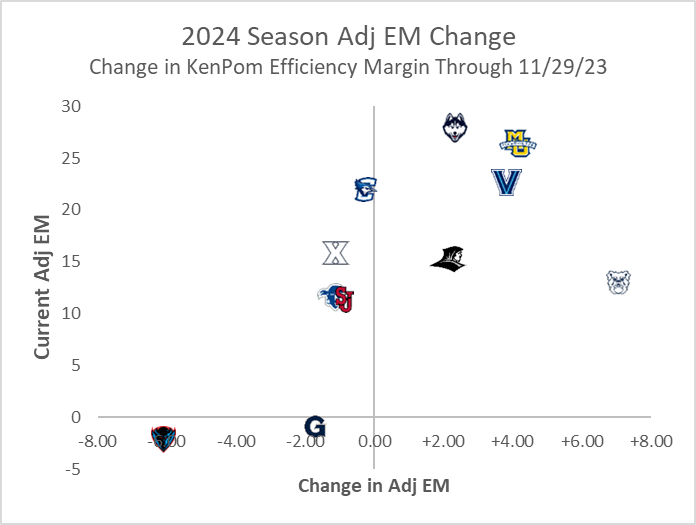
What this tells us is that based on the results to date, which comprise over half the non-conference season, the Big East as a whole is much, much worse than expected.
Bart Torvik
Maybe you are one of those people that think computer models like KenPom can’t be trusted until January, when the preseason expectations filter out of his model. In that case, I would point you to Bart Torvik’s TRank, which lets you filter out that “bias” from the equation.
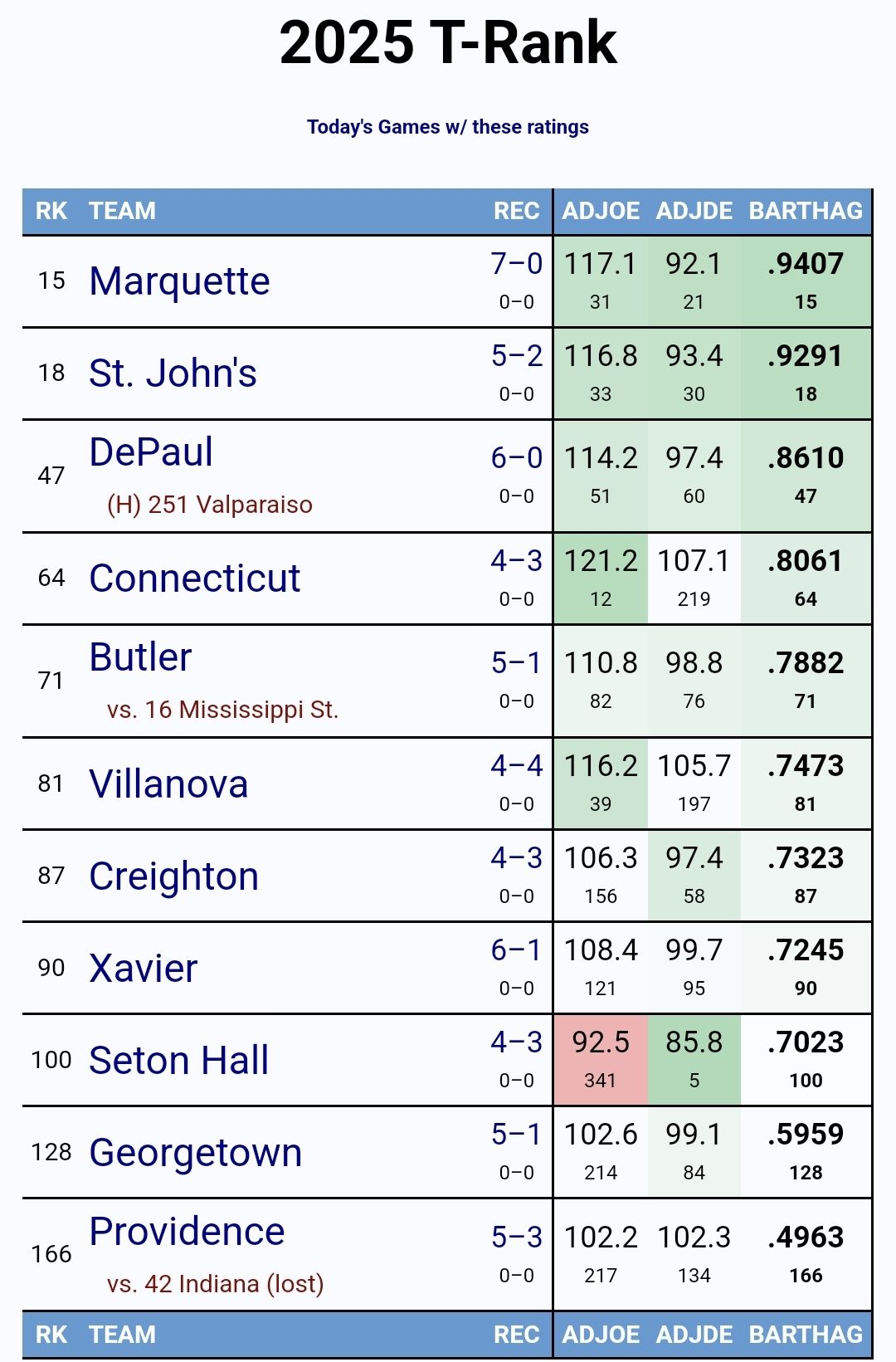
Here, the conference has 3 top-50 teams and 6 sub-80 teams. It is really, really bad.
WAB
While KenPom and Torvik are awesome and incredibly useful, they are not exactly a great barometer for NCAA Tournament bids. St. John’s finished 21st in the country in the Ken Pom rankings last season, and wasn’t even the first team left out. What matters as much, if not more, is resume strength, which is based on wins and losses more than 30+ point beatdowns of cupcakes and keeping losses close.
And for the first time ever, the committee will use a metric that is incredibly easy to understand when evaluating resume strength in Wins Against Bubble, or WAB for short.
If you want a long explanation, what I wrote this offseason still checks out: https://painttouches.com/2024/09/05/who-has-the-toughest-non-con-schedule-in-the-big-east/. But a short explainer, WAB gives points for any win and takes away points for losses, based on how “difficult” the game was based on opponent strength and venue.
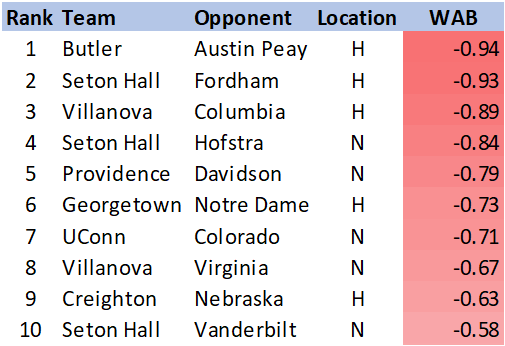
Butler losing to Austin Peay took away .94 points while their wins over Northwestern (+0.47) and SMU (+.31) added a combined .78 points, not yet fully offsetting that disastrous loss. Add up all those wins and losses, and you start to see just how much trouble the conference is in.
Ideally, you want to be around 0 to be considered a bubble team. The conference has 8 teams currently below 0.
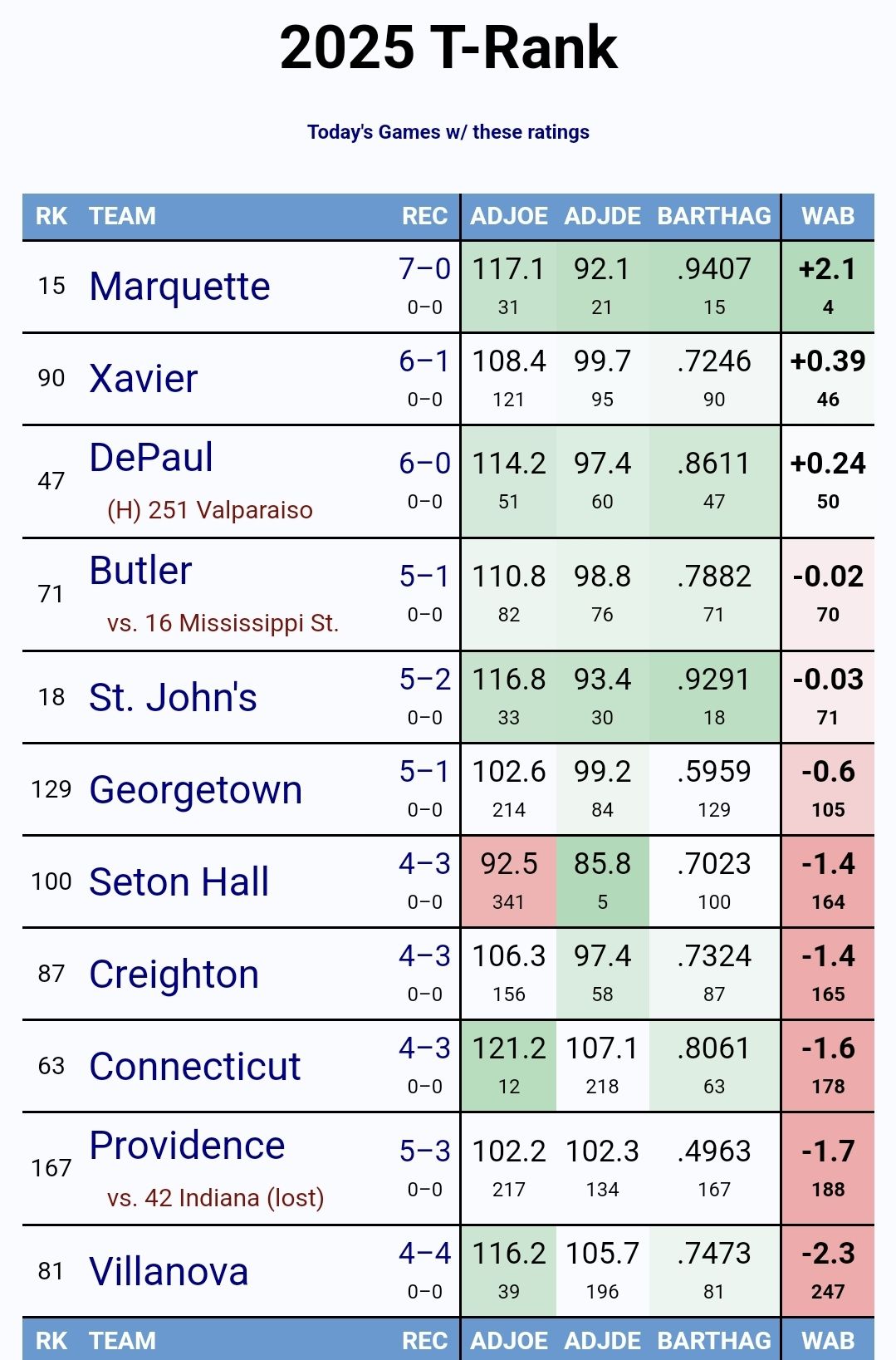
The league has 12 losses worth -0.5 or more compared to just 4 wins worth 0.5 or more. And of those 4 wins, Marquette has 3 of them.
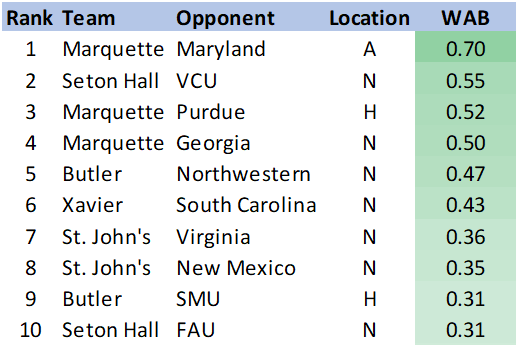
For en example of just how dangerous home losses to cupcakes are…
There isn’t much time for the conference to turn most of these WABs around, if we’re being honest.
Zero Sum
And the reason for that is that conference games are zero-sum exercises. If there is a winner, there has to be a loser. And both come from the same conference pool.
Let’s take Seton Hall for example. Last season, they struggled in the early portion of the non-conference season, going 5-4 in the first 9 games. The Pirates went into Big East play ranked 117th in the country with a WAB of -1.8. Bad metrics and bad resume strength.
They then proceeded to put together an excellent conference run, going 13-7, beating UConn, Marquette and St. John’s and generally performing like an NCAA Tournament team from every perspective, including a top-40 ranking in Torvik during conference play. Except for the fact they had played like a sub-100 team for the portion the committee always puts an emphasis on.
For the Big East’s sake, having Seton Hall, the 3rd worst performing team in the noncon, right the ship in the conference season was suboptimal, because it came at the expense of other bubbly teams like St. John’s, Villanova and Providence with better nonconference resumes.
You would much rather have a team flame out in conference play (like Butler last season) than during the noncon (like Hall).
And this is the reason why I’m always so pro-Big East every season. Even if you hate a team, coach or player, the conference’s small numbers and double round robin mean your opponents have a huge impact on your resume. Sure, a team can go 18-2 and not have to worry about what anyone else does, but that’s a rare occurrence. If 5 of the teams you will play are going to be sub-100, that means 1/3rd of your schedule is subpar, and you can’t afford to lose those games or significantly hurt your resume.
Q1 Opportunities
To put this in one more view, we always hear how important Q1 games are from the pundits and selection committee members. Quadrants are calculated using the NCAA’s NET formula, where it adjusts for opponent strength and location of the game.
Last season, St. John’s played 10 regular season Q1 games in conference, with UConn, MU, CU all being Q1 home and away, while Nova, PC, X and Hall were all Q1 for the away game. That is a very high number and gives teams plenty of chances to collect those coveted Ws.
While it’s still early and NET doesn’t get revealed until next week, Torvik’s projections have St. John’s only playing 8 this season, and that’s with the assumption Butler and Villanova (borderline cases) stay in the top-75 while UConn figures it out and stays top-30.
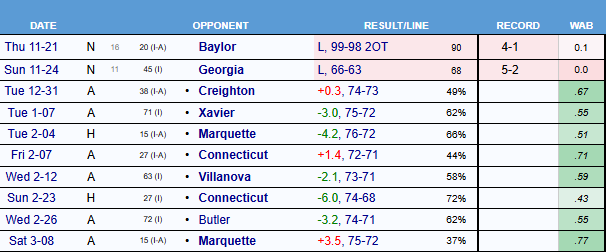
Factor in that St. John’s already lost the only 2 Q1 games it had scheduled in the noncon, and you can see how a team with great metrics is still a bad 2-week stretch from sweating it out on Selection Sunday.
And one more thing, this is just all to say the league will struggle to get more than 4 teams into the dance, not even factoring most of those would be mid-to-low seeds.
Doom time?
This is a huge week coming up as the Big East/B12 Challenge is the lost cross-conference opportunity to change not only perception, but metrics. Once the noncon ends, the league will be battling itlsef for the last 2 or 3 life rafts.
Maybe you are a Marquette fan and don’t care about the carnage below. Or maybe you’re a DePaul fan and are enjoying being able to truly tell other fans to pull their weight for once. But no matter your affiliation, it’s a fact that the combined struggles mean bigger lifts are need for any 1 team to simply get where they would have gotten with an average league performance.
It’s getting late early, and the conference’s NCAA Tournament revenue payouts look to be mediocre once more. All Big East teams will be feeling the pinch.
Make a one-time donation
Make a monthly donation
Choose an amount
Your contribution is appreciated.
Your contribution is appreciated.
DonateDonate monthly


 Paint Touches
I appreciate your column. I especially enjoyed it when it was just about Marquette since I am an old alum ’70,’72, from the Mcquire years. However, you have understandably gone “Big East” to make some “bread,” as we would have said back then. Unfortunately for my feeble brain, your statistical abbreviations are beyond my comprehension. For example, in your latest article: “ADJOE, ADJDE, BARTHAG.”
A Glossary of terms may help if you want to avoid putting footnotes or explanations of terms in your articles. I was not a journalism major at Marquette, so please forgive my suggestions.
Keep up the good work.
M West mwest48236@gmail.com