In case anyone was curious, Tyler Kolek and Oso Ighodaro, two top-40 NBA draft picks this summer, were pretty good. With those two leading the way, Marquette finished back to back seasons with top-25 offenses the past 2 seasons, per KenPom, and were the 4h and 5th most efficient offenses for a Marquette team since 1997.
Taking it one step further, with those 2 on the court at the same time, Hoop-Explorer tells us Marquette’s offense scored 120.3 points per 100 possessions, adjusted for quality, in 2024 and 123.5 pts/100 poss in 2023. That’s 2.8 and 9.7 points better than MU posted when TK and Oso didn’t share the court the past 2 seasons, respectively.
But we already knew that and we don’t really need a deep dive to tell us what the eye could clearly see. What we do want to use advanced data for isn’t what is obvious, but instead to what is yet to be. Mainly, what will Marquette’s offense look like like without two of the best creators in MU history?
Kam Time
To start this, I wanted to drill in on all-American hopeful Kam Jones. When Kolek missed 6 games late last season with an oblique injury, Kam didn’t just fill in admirably, he showed that as good as we already knew he was, he had another level of potential yet to be tapped.
Here are the regular season and Big East Tournament splits for Kam playing with Kolek, vs when TK was out injured.

I highlighted the a few of the portions I think are most revelatory.
One, without Kolek, Kam’s minutes went up from “significant starter” to “can’t take him off the floor” level. Yes, it was only 6 games and this won’t be the case this upcoming season, but in general, you can bank on Kam getting 30+ minutes outside of cupcakes and injuries. He’s THE key cog.
Two, despite playing significantly more, Kam’s usage jumped from 24.3% to 28.8%, over 5 points. Yes, it’s a limited sample, but this is something I absolutely do think will be the case next season. Kam will garner the most attention by far, but as the primary ball handler for a majority of the minutes he’ll play, he will see a marked increase in the possessions he uses. My only question at this point is, will he be the first Marquette player since Markus Howard to cross the 30% mark? (Data below from BartTorvik.com)
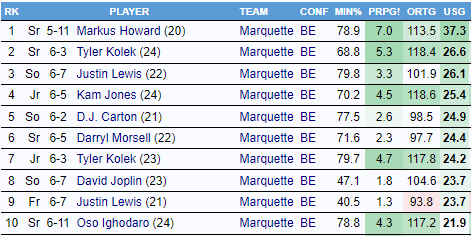
The smart money is on “no” as no MU player has even crossed the 27% threshold the past 4 seasons. But I do think Kam will come close. Barring a sudden early return from injury from Sean Jones, or an unexpected leap from a ballhandler like Tre Norman or Chase Ross, a huge portion of the offense will fall on Kam’s creative abilities. No, he won’t be taking up a Markus reincarnated level, but I’ll be very shocked if Kam doesn’t show up as the no. 2 on this list come April.
Back to our count, three, take a look a the PRPG! number of 6.8. For those that need a refresher, PRPG! is basically a way to factor minutes played and usage into efficiency. Having an ORtg of 150 in 10 minutes a game on 2 possessions is fine, but it’s significantly less impressive than and ORtg of 105 in 33 minutes a game on 20 possessions. So PRPG! bakes all that in to give us comparable numbers.
Kam’s 6.8 blows away his previous 4.1 with Kolek, even with a lower eFG% and higher TO rate, because he was playing many more minutes and using many more possessions. So once more I’d expect Kam’s ORtg to dip to around 110ish if he does reach 30% or so usage, but it will come with a much higher PRPG! than he’s ever had because being able to remain efficient at high volume is a skill only elite player, like him, possess.
Fourth and final point, I’ve talked a ton about Kam shooting and scoring, but the thing those 6 games without Kolek sealed for me is that I miscast Kam as a scorer. Yes, he’s one of the best in the country at that, but he’s an incredible creator for others as well. When thrust into PG duty during that stretch, Kam nearly doubled his assist rate from 14.4% to 28.8%. And did so while his TOs only budged slightly from 9.7% to 12%.
I have a feeling we will be seeing the Kam/Ben pick and pop a whole bunch this upcoming season.
All of this is to say, Kam will have the reins of the offense in 2025, and I have full faith in his capable hands.
Play Types
As much as I’d love to just leave this analysis at that, I still haven’t answered the question. So I dug into Hoop-Explorer a bit to see what we might be able to learn in terms of the HOW.
Hoop-Explorer allows us to filter possessions with certain players on or off, and remove the garbage time possessions while we’re at it. And then it not only adjusts for opponent quality, it also separates out the possessions by play type.
Below we have the 2024 Marquette data with Kolek and Oso on the floor (1592 possessions). For ease of understanding, the height of the chart compares the play type’s usage vs the rest of D1 and the color measures the efficiency. So Marquette was near the 90th percentile with 20 transition play types per 100 possessions, and the dark green indicates the 1.45 points in the paint was among the best in D1. On the other hand, MU took very few dribble jumpers (3.0) and did so at below average efficiency (0.70).

I wanted to set the TK/Oso baseline because those two were magicians at getting others in great scoring position. As much as I loved watching Marquette’s offense flow the past 2 years, it doesn’t really make sense that it will look the same without them.
So I pulled all the (non-garbage) possessions without them, from last season, which amounted to 164. Here’s what the possession distribution looks like.

The first caveat is this is an incredibly tiny sample. Marquette had 2,215 non-garbage possessions last season, so this only amounts to a tiny 7.4% of them. It is not meant to be a robust analysis, but rather a sampling of what might be. The second is that the team had been oriented around Kolek and Oso for 2 years, so of course it would look a bit ragged and inefficient the few possessions a game (or full Creighton game) without them. When Marquette next sees the court in November, it will have spent over 6 months specifically building an offense around Kam and Ben and Jop and Chase.
Since it’s difficult to compare those 2 bar charts against each other, I put the data in a table to compare the volume and efficiency with TK and Oso on the floor and then without.
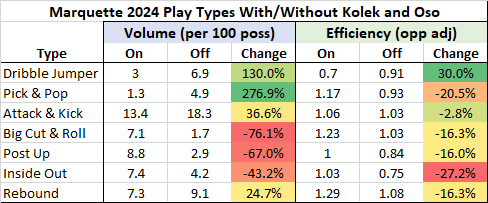
The first thing I noticed was the marked increase in both pick and pops as well as dribble jumpers. When Oso and Kolek were on the court, Marquette averaged 4.6 of those possessions per 100 trips down the floor. With both of them off, Marquette’s attempts went up by 157% to 11.8.
Although I’ve already caveated making any huge conclusions from such small samples, this is one where I do think we see a robust increase next season, primarily because for all of the ball handling Oso did last season, you can count the number of pick and pops and dribble jumpers he took on one hand. So when those possessions get split up between Ben and Jop, both capable shooters, it would only make sense that shooting volume increase significantly. Similarly, dribble jumpers were the weakest part of Kolek’s arsenal and while Kam isn’t as efficient pulling up vs driving or spotting up, there will be a good number of end of clock scenarios where I can see Kam (or Jop) needing to fire off the dribble.
Ok, we will see more shooting, but is that a good thing? This is probably where I’m most concerned about the offense next season, as you are trading Oso’s rim runs and Kolek’s pocket passes toward the basket for floor spacing treys.
Which brings us to…
Ben Gold
Although we did see some extended runs from Gold, particularly late in the season, moving from Oso’s style to his is as large a shakeup in styles as we may have ever seen from one year to the next.
Trying to paint a picture of how unique Gold is, I went for a deep dive in Bart Torvik’s database, which has data since 2008. I filtered my search for players 6’10” and taller who took at least 100 3s in a season. There isn’t anything particularly special about that number, but just a rudimentary cutoff for very tall players that had a very bright green light to shoot from distance. I then narrowed it down to just high major players, as the opponent quality would have a big effect on this particular stat.
And what we got back was a table with 78 high major, 6-foot-10-or-taller players who had robust volume from behind the arc. Of those 78, none has ever had a higher 3-point rate than Ben Gold’s 78% last season. For those unfamiliar, 3-point rate just divides 3s by all field goal attempts to determine what percent of shots come from distance. And Gold’s 2024 shot distribution is as lopsided as we’ve ever seen for a player of his size.
While taking a majority of your shots from distance isn’t necessarily a bad thing, I don’t think we see that same shot distribution in 2025, not only because Gold will play a more integral role, but also because he’s actually a very, very good finisher inside the paint. Of those same 78 players, only 1 had a better 2-pt percentage inside the arc than Gold.
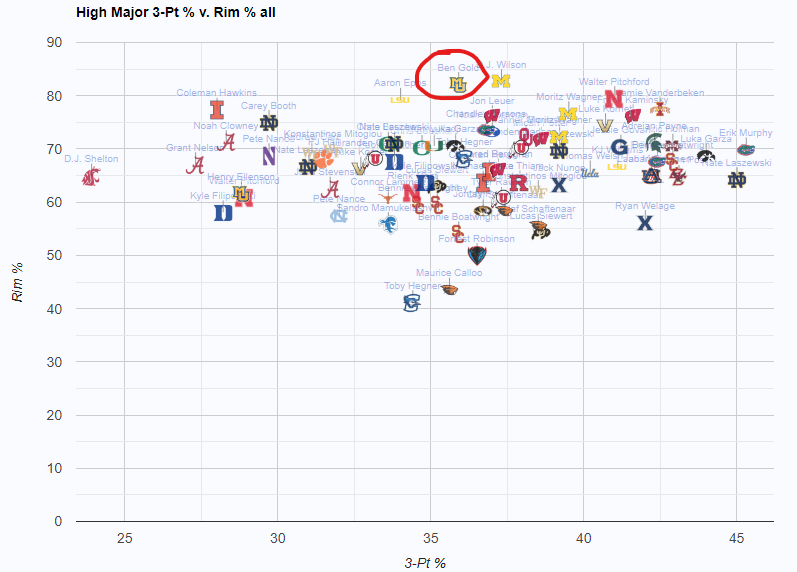
Granted, the sample size is less than one 2-pointer per game, with 33 total attempts, but I have a feeling we will see a significant increase in drives from the perimeter from Gold this season. I can’t get this play out of my mind as a harbinger of what a fully developed Gold could look like.
Open Shots
Going back to his shooting, though, that Creighton game is still etched in my head. Gold had so many, good open looks. Synergy logged 6 of his 8 attempts as being unguarded, the most he took al season. And yet he only went 1-8 from distance.
It wasn’t an anomaly, either. On the season, Gold only shot 26.4% from 3 on unguarded catch and shoot jumpers. That’s really bad and makes absolutely no sense when you compare to his guarded shooting number, where he hit 43.8% of 3s and was in the 94% nationally in efficiency.

And this isn’t to pick on Ben, either. Looking at the returners, only Kam had a “normal” split between guarded and unguarded efficiency.
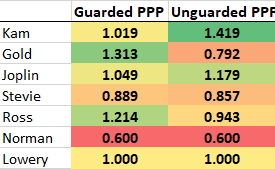
And the volume of shots, which help show us the distribution.
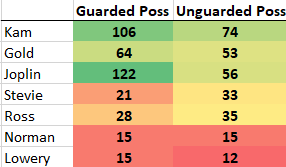
This was something I monitored all season, Marquette was below average in hitting unguarded shots and it made no sense. It finished in the 32nd percentile in 2024 with 1.07 points per shot while landing in the 92nd percentile for guarded spot ups. It really makes no sense considering Marquette hit 1.18 PPS in 2023 with nearly the same roster.
And all of this is to say, even with excellent process, there was weirdness in the results. I have no idea if Marquette will be better, but what I still expect is that a Nevada Smith offense will create lots of open looks in good spots. That won’t always mean a great percentage made, but the process will be sound.
Make a one-time donation
Choose an amount
Or enter a custom amount
Your contribution is appreciated.
Donate


 Paint Touches
Leave a comment