After a full weekend to digest the Big East’s announcement of a new TV media deal through 2031, reportedly worth $480 million, about $80 million per year, I wanted to take some time out and put additional context on that number, other than the fact that’s it’s huge, and nearly doubles the previous contract signed in 2013.
What are other power conference TV deals worth?
I probably have 13 different spreadsheets and documents at various levels of completion with this info, but it’s always such a struggle to put it all in one place. So I wanted to make it easier for anyone else interested to know.
Thanks to Business of College Sports and the Sports Business Journal, here are the contract values and other key points for each of the Power 5 conferences, plus the PAC-12 for scale.

If you are just looking at raw totals, you can see how puny the Big East’s media deal is compared to the other power conferences, even one that’s now defunct. I don’t think you need a chart to visualize the gap, but here it is anyway.
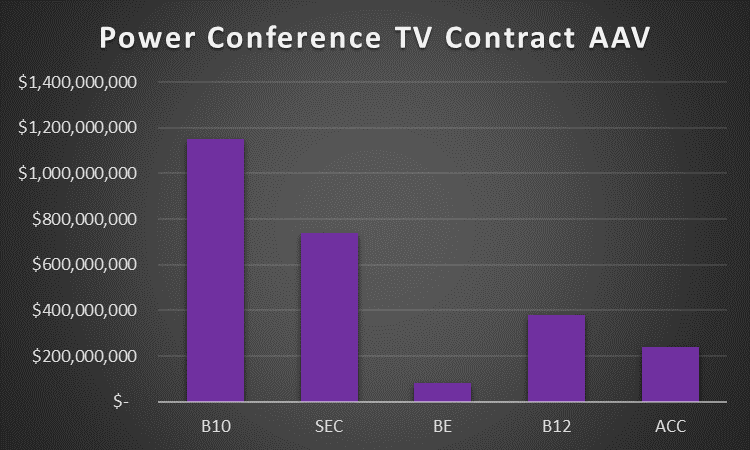
Of course, the only thing this chart is telling us is that football is king, and the Big East does not play football. So a better question is…
What are other power conference basketball TV deals worth?
To get to this answer it’s important to do a little prep work. Even though basketball and football are the two most popular, and lucrative, NCAA sports, does not make them equal in the slightest. TV ratings for college football games dwarf those for college basketball, and the money has followed suit.
In 2020, Michigan State’s NCAA Report filings broke out the media revenue between football and basketball at an 80/20 split, meaning 80% of it was attributed to football ($35.9M) while only 20% was attributed to basketball ($8.9M). And this is at a school where basketball is significantly more prestigious and successful than football.

So when I was modeling what Big East TV rights were worth, I used that 80/20 split as a rough heuristic. Adding in the information from the table above, we get this rough breakout for how media companies value each conference’s basketball rights.
I’m not 100% sure how each league and contract treats new members, so didn’t assume they’d get a full pro-rated bump, instead just relied on dividing the “basketball cut” of the contract’s average annual value, AAV, by the number of teams in the conference when the deal was signed.
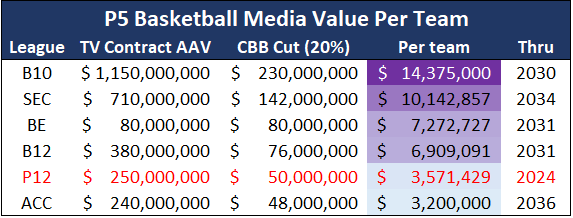
In this calculation, the Big East will now be the 3rd most valuable basketball property in Division 1, slightly outpacing the B12’s deal it signed last season. Yes, there are caveats and asterisks and assumptions made to get to these numbers, but even assuming there is some error baked in, FOX, TNT and NBC have combined to show the conference is as valuable as they come, outside of the top 2.
But in analyzing the top 2, I think it makes sense to say the 80/20 split probably no longer applies, as football’s impact both in TV ratings and bottom lines has ballooned. The Big Ten and SEC have great basketball leagues and massive followings, no doubt, but the big bucks they are seeing are based primarily on their football hegemony. They have the most valuable football brands and games, and the premium being paid for those brands has very little to do with basketball.
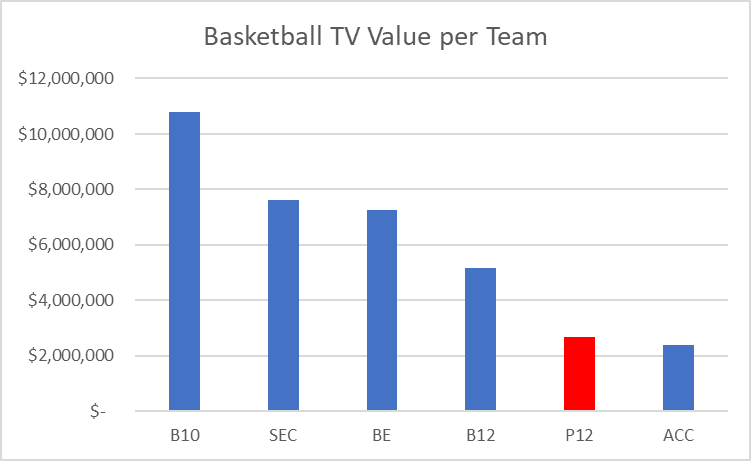
Going forward, I’m going to move to an 85/15 model for TV revenue distribution, where college basketball only accounts for 15% of the media pie. And that would give us something like this.

You still have the top 2 in the same order, with Big Ten basketball alone worth nearly $11M a year, but now the SEC’s second fiddle comes closer to what the Big East and Big12 are receiving.
What does this mean?
And so once more I will shout from the rooftops, no matter if you think basketball is worth 15% or 20%, the current contract the Big East has earned puts it as the 3rd most valuable basketball entity, and cements once and for all that the league did extremely well in its negotiations.
No, that won’t make UConn fans any happier about the dollar amount that still keeps them in no-man’s land for their football, but it’s undeniable that Big East content was valued in the same breath, if not a tad more positively, than a like-for-like comparison of Big 12 basketball, signed just one year prior, even if you want to keep the 80/20 split.
And then there’s the ACC. Hoo boy, if you ever want to make someone mad, just tell them DePaul and Butler will be doubling what Duke and North Carolina are getting directly from TV revenue for their basketball. No, that doesn’t mean DePaul and Butler are twice as valuable, just driving home how poorly the ACC did in TV negotiations, locking in to an eternal under-market deal.
I will add that the other 4 Power leagues will augment their hauls with additional bowl and College Football Playoff payments, so all have more revenue streams that can and do bolster the basketball product. The money between the Big East and those leagues will never align.
But speaking specifically to the media value, the Big East has proven the initial commitment from FOX in 2013 to be beneficial for both parties, and has reaped the results of a second contract that makes it one of the top college basketball rights deals in the country.


 Paint Touches
Trackbacks/Pingbacks
[…] on this new landscape, bolstered by a lucrative TV media deal that runs through 2031. This deal is reportedly worth $480 million, averaging about $80 million per year. According to Paint Touches, the new deal […]
[…] How does the the Big East TV contract compare to other power conferences? […]